Direct answer
An editorial calendar sets which topics and messages a brand publishes and when, at campaign level. A content calendar goes down to each post: network, format, date, time, owner and review status. Small teams usually keep both in one sheet, with a campaign view and a post view.
Editorial calendar vs content calendar: what the question actually asks
When teams ask about editorial calendar vs content calendar, they are usually not asking for a dictionary definition. They are asking which planning structure will actually hold up once several brands, several networks, and several people are involved. The two terms overlap so much in everyday use that the real comparison isn't about labels - it's about what each approach forces you to decide upfront and what it leaves to be figured out later.
An editorial calendar, in most agency and marketing usage, is organized around themes, campaigns, topics, and publication timing - the 'what are we saying and when' layer. A content calendar tends to be organized around the assets themselves - which post, video, or carousel goes where, in what format, on what account. Neither is inherently better; they answer different questions, and small teams juggling multiple brands often need both, even if they call it by only one name.
Why brand context changes the comparison
The comparison shifts once you're producing for more than one brand. A single-brand editorial calendar can live comfortably in a shared doc because tone, voice, and audience are implicit - everyone on the team already knows them. Add a second or third brand, and that implicit context has to become explicit somewhere, or every calendar entry turns into a round of clarifying questions about who this brand is and how it talks.
This is where the distinction starts to matter practically rather than semantically. A content calendar without brand context is just a list of dates and formats - it doesn't tell a contributor what makes this brand's carousel different from another brand's carousel. An editorial calendar that does encode brand context - audience, tone, recurring themes - gives production a foundation to work from, even before a single asset is drafted.
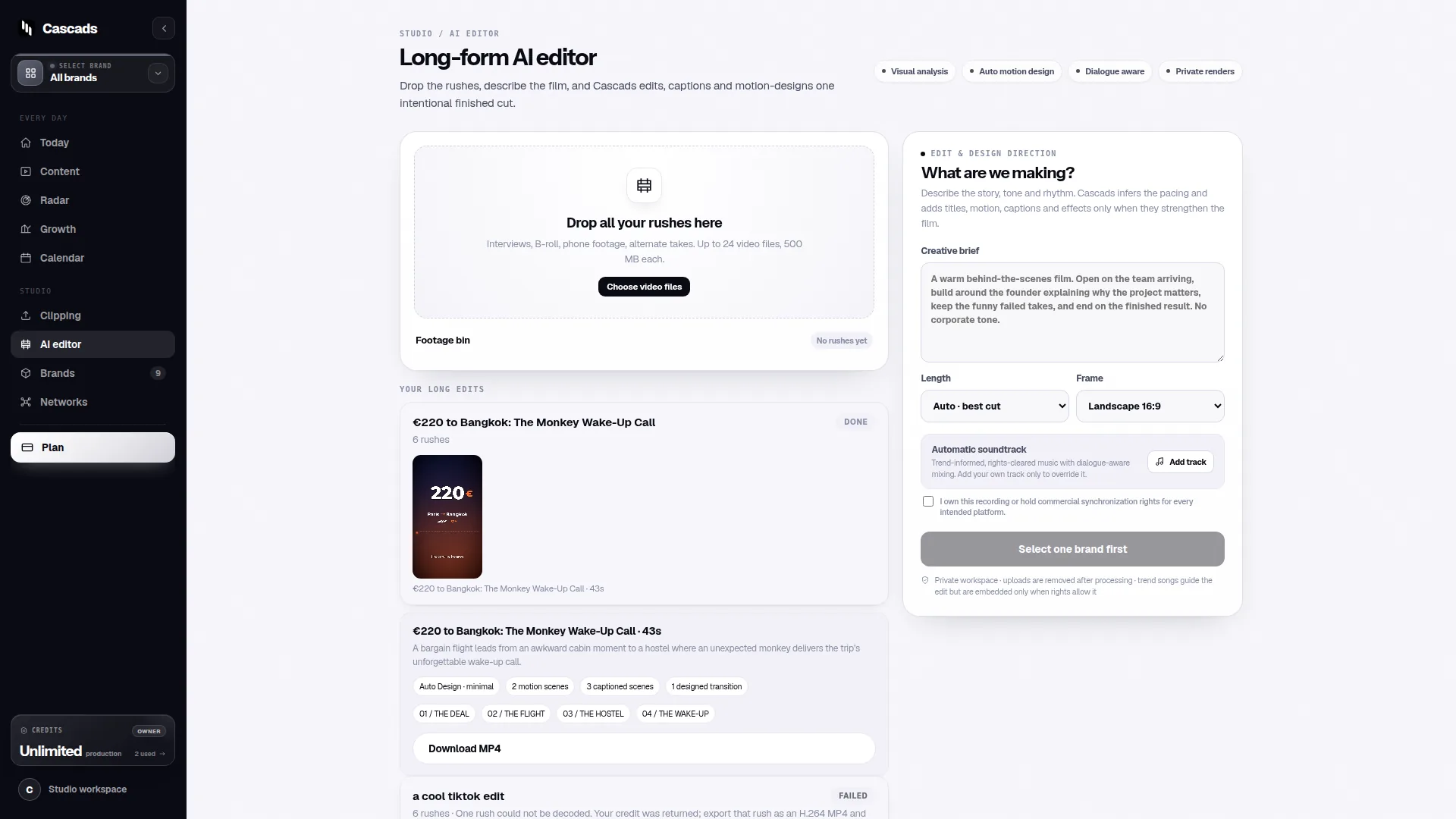
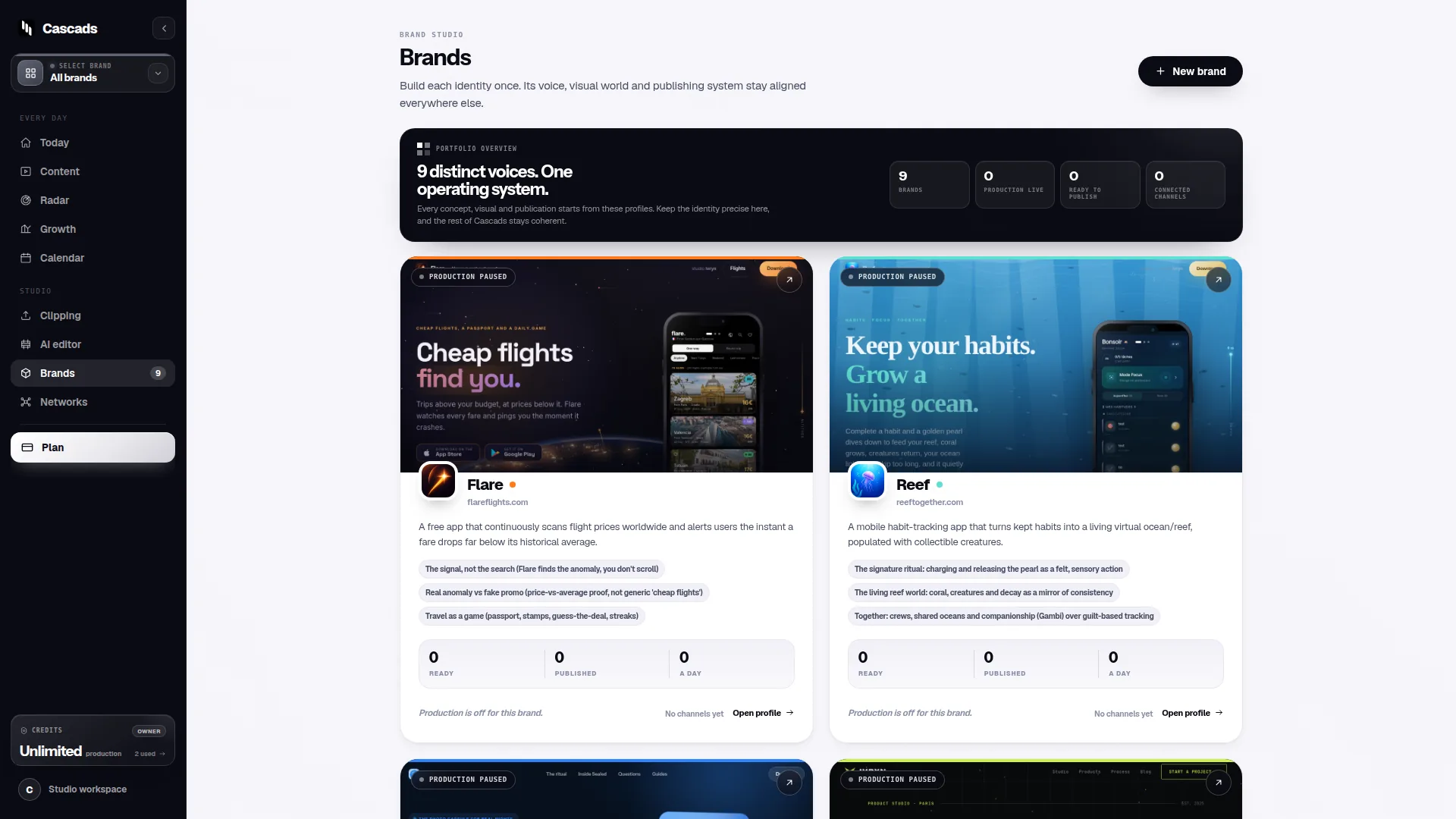
Cascads, an IVRYN product built for social content production and scheduling, works from a reusable profile for each brand rather than a single generic template. That structure is closer to how a brand-aware editorial calendar should function: the brand context is defined once and referenced repeatedly, instead of being re-explained in every planning conversation.
Multi-format production changes what a calendar needs to track
A calendar built around text posts alone looks very different from one that also has to account for vertical video and carousels. Format isn't a footnote - it changes production time, review steps, and how content gets adapted per platform. A calendar that only tracks 'topic' and 'date' will quietly break down the moment a team is producing three formats across three networks for three brands at once.
Practically, this means a workable calendar - editorial or content - needs at least three layers of information: the underlying idea or theme, the format it will take, and the specific brand and network it's destined for. Cascads generating text posts, vertical videos, and carousels from a shared brand profile illustrates one way to keep format variation from multiplying planning overhead, but the underlying principle applies regardless of which specific tool a team uses: format-awareness has to be built into the calendar structure, not bolted on afterward.
Human review is not optional, whichever calendar you choose
Whatever structure a team adopts, generated or drafted content still needs a human review step before publication. This is true whether the calendar is organized editorially or by content asset, and it's especially true for multi-brand operations where a mismatched tone or an off-brand claim in one account can be more costly than a delayed post.
A common mistake is treating the calendar itself as the review mechanism - assuming that if something is scheduled, it has been checked. In practice, the calendar should make review a visible, trackable step, not an assumption. This is one of the few genuinely universal principles across editorial and content calendar formats: neither replaces a review workflow, and neither should be built without one.
A worked example: comparing the two approaches for a five-brand agency
Consider a hypothetical five-person agency managing five brand accounts across Instagram, LinkedIn, and TikTok. This is an illustrative scenario, not a case study or reported outcome.
If the team adopts a pure editorial calendar - themes and dates only - they gain a clear view of messaging cadence across brands but lose visibility into which formats are due when, and reviewers can't tell from the calendar alone what's ready to check. If they adopt a pure content calendar - assets and dates only - they gain production visibility but lose the thread connecting posts to a coherent brand narrative, and campaigns can drift without anyone noticing.
In this hypothetical, the practical answer is neither calendar alone: the team needs an editorial layer (brand, theme, cadence) feeding into a content layer (format, asset, review status, publish destination). Because publishing itself depends on the network, media format, account permissions, and external platform approval, the content layer also needs to flag which items are cleared for direct publishing and which need manual posting - a detail that a theme-only editorial calendar would never surface.
A short decision checklist
Rather than choosing one label over the other, teams comparing editorial calendar vs content calendar for a multi-brand, multi-format workflow can check for these capabilities:
- Does the calendar carry brand context (tone, audience, recurring themes) rather than relying on shared team memory?
- Does it distinguish format (text, vertical video, carousel) as a first-class field, not an afterthought?
- Is there a visible, mandatory human review step before anything is marked ready to publish?
- Does it flag platform-specific publishing constraints - network, format, account permissions, approval status - rather than assuming every scheduled item can post directly?
- Can one entry connect a theme or campaign (editorial) to a specific asset and destination (content) without duplicating work?
Choosing based on how your team actually works
If a team already thinks in themes and campaigns and struggles mainly with turning those into finished assets, starting from an editorial calendar and layering production detail onto it tends to feel more natural. If a team already produces a high volume of assets and struggles with keeping them on-message across brands, starting from a content calendar and adding a thematic layer on top may fit better.
Either starting point is workable, provided the final structure includes brand context, multi-format tracking, a real human review checkpoint, and awareness that direct publishing is conditional rather than guaranteed. Tools like Cascads, which generate multi-format content from a per-brand profile, are relevant here specifically because they tie the editorial and content layers together through that shared brand definition - but the underlying checklist matters more than any single tool.
Frequently asked questions
Is a content calendar just a simpler version of an editorial calendar?
Not exactly - they emphasize different things. A content calendar typically tracks individual assets, formats, and publish dates, while an editorial calendar tracks themes, campaigns, and messaging cadence. Many working calendars combine both layers rather than treating one as a simplified version of the other.
Do I need separate calendars for each brand if I manage several?
Not necessarily separate documents, but you do need separate brand context within whatever calendar structure you use. Without distinct brand information - tone, audience, recurring themes - for each brand, planning entries become ambiguous and contributors have to guess or ask for clarification repeatedly.
Can a calendar guarantee that scheduled posts will publish automatically?
No. Direct publishing to a given network depends on factors outside the calendar itself, including the platform, the media format, the account's granted permissions, and approval processes controlled by the external platform. A calendar can track publishing status, but it cannot override those external constraints.
Sources and further reading
These resources provide the wider reference frame. Product statements on this page are limited to the public information provided by Cascads.