What social media automation ai actually changes in a content workflow
When people talk about social media automation ai, they usually mean two different things at once: software that drafts content, and software that also schedules or posts it. Those are separate capabilities with separate risks, and conflating them is where teams get into trouble. Drafting help can speed up ideation and reduce the blank-page problem across text posts, short videos, and carousels. Publishing help touches live brand accounts, which means mistakes are visible immediately and to the wrong audience.
A useful way to evaluate any tool in this category is to ask where the automation stops and a human decision starts. If the answer is vague, that's a signal to look closer before adopting it for anything customer-facing.
Why brand context matters more than raw output volume
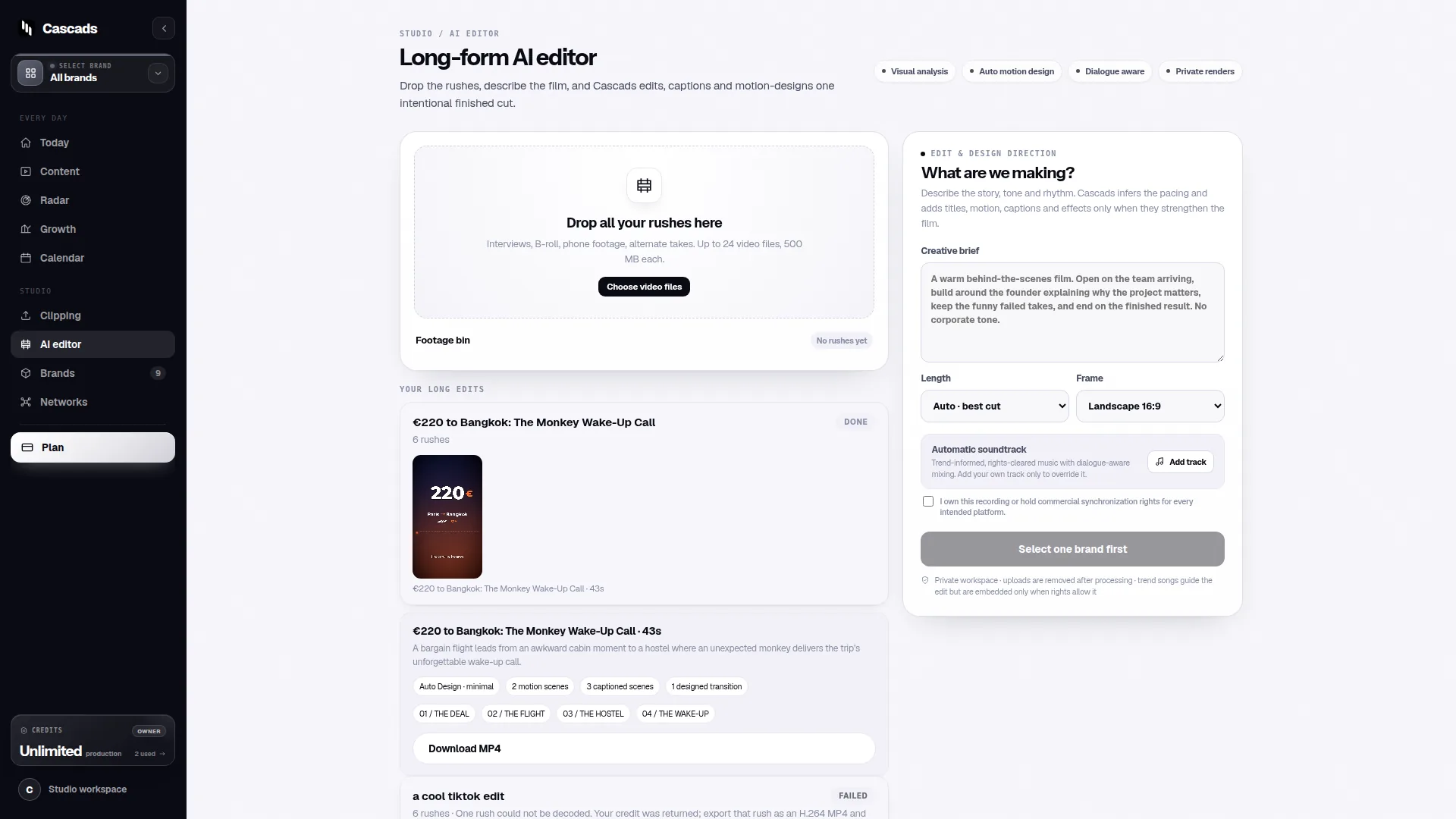
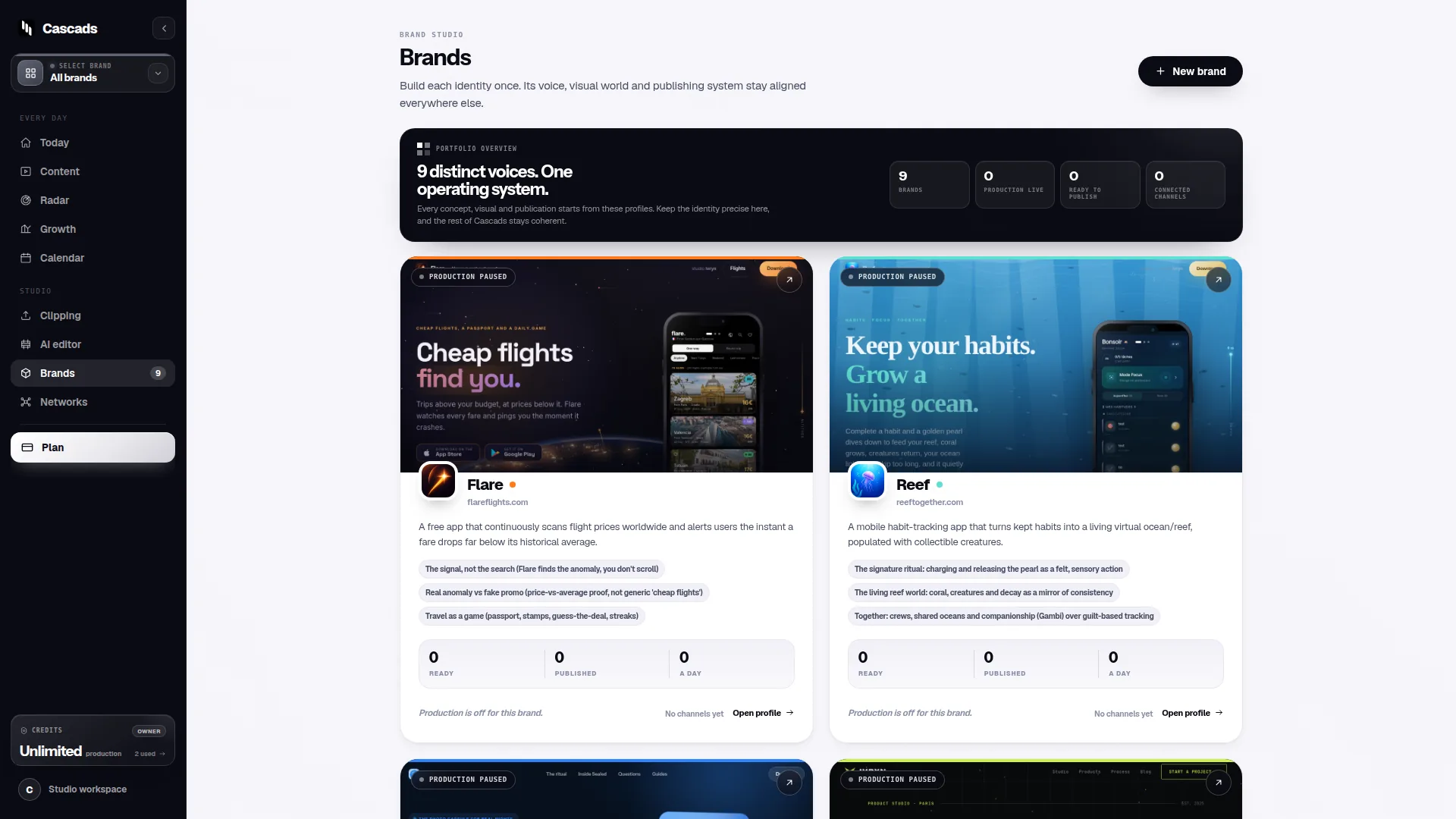
A small team managing several brands doesn't need more content ideas; it needs content that sounds like each specific brand without someone re-explaining tone, audience, and constraints every time. This is the practical argument for tools built around a reusable brand profile rather than a single generic prompt box. Cascads, an IVRYN product for social content production and scheduling, works this way: each brand keeps a profile that the generation step draws from, so a carousel for one client and a vertical video for another don't default to the same flattened voice.
This matters for agencies especially, where switching context between accounts several times a day is normal. A profile-based approach reduces the manual re-briefing that eats time, though it doesn't remove the need for someone who knows the brand to check the result before it goes out.
Multi-format production and where it tends to break down
Text posts, vertical video, and carousels are not interchangeable outputs of the same idea; each format has its own pacing, length, and visual logic. A caption that works as a static post rarely translates directly into a script for a nine-second vertical video, and a carousel needs a sequence of ideas that build rather than a single paragraph split into slides. Automation that generates across these formats from one brand profile can save real setup time, but the quality gap between formats is usually uneven - video tends to need more human polish than text.
Teams should expect to spend proportionally more review time on video and carousel output than on text, at least until they've calibrated the tool's defaults to their brand's actual style.
- Text: check facts, tone, and calls to action
- Carousels: check slide sequencing and whether the narrative holds together
- Vertical video: check pacing, captions/subtitles, and whether the script matches the visual
Human review is not optional, and here's a worked example of why
Generated marketing output remains subject to human review before publication, and this isn't a compliance formality - it's where brand judgment, legal sensitivity, and platform norms actually get applied. Consider a hypothetical: an agency uses automation to draft a week's worth of posts for a skincare brand ahead of a product refresh. The tool, working from the brand profile, produces text posts, a carousel comparing old and new packaging, and a vertical video script.
In this example, a reviewer catches that the carousel implies a clinical claim ('clinically proven') that isn't in the brand's approved claims list, and that the video script uses a competitor's product name in a comparison the legal team hasn't cleared. Neither error is a failure of the automation exactly - the tool doesn't know what's legally approved this quarter - it's a demonstration of why review sits before publication rather than after. A defined approval workflow, where drafts move through specific reviewers before anything goes live, is what catches this kind of thing consistently rather than by luck.
This is also where a documented review workflow, such as the one Cascads publishes for its own product, does real work: it turns 'someone should check this' into a specific step with a specific owner.
Format-aware publishing and the limits worth knowing upfront
Even after content is approved, getting it live is not guaranteed to be a single click. Direct publishing depends on the network, the media format, the account's permissions, and approval from the external platform itself - none of which is fully within any third-party tool's control. A network might change API access, a video format might not meet a platform's current spec, or an account might lack the permission tier needed for scheduled publishing on a given feature.
Practically, this means teams should treat direct-publish claims as conditional rather than universal, and should verify format and permission requirements for each network before building a workflow that assumes seamless posting everywhere. A publishing integration checklist is useful here specifically because it turns these platform-by-platform conditions into something checkable rather than something assumed.
A simple decision aid for evaluating fit
Rather than asking 'is this tool good,' it's more useful to ask a short set of questions specific to how a team actually works across brands and networks. The following is a hypothetical checklist a small agency might use before adopting a social media automation ai tool - not a Cascads-specific requirement, just a reasoning tool.
- Does it store a distinct profile per brand, or does everything funnel through one generic voice?
- Does it generate the specific formats we need (text, vertical video, carousel), and how much editing does each typically require?
- Is there a clear review step before anything reaches a live account?
- Does it document, per network, what's needed for direct publishing (permissions, format, approval)?
- What happens when a network changes its rules - does the workflow degrade gracefully or break silently?
Where this leaves a team deciding today
Social media automation ai is genuinely useful for reducing the repetitive parts of multi-brand, multi-format content production, particularly the drafting and brand-context work. It is not a substitute for a review step, and it is not a guarantee that content will publish automatically everywhere without friction. The realistic framing is: automation compresses the drafting phase, humans still own the judgment phase, and platforms still control the final publishing phase.
Teams evaluating tools in this space should look specifically for reusable brand profiles, format-appropriate output, a built-in or compatible review workflow, and honest documentation about platform publishing limits - rather than promises that any of those steps can be skipped.
Frequently asked questions
Can social media automation ai publish directly to any platform without extra setup?
No. Direct publishing depends on factors outside any single tool's control, including the specific network's rules, the media format involved, the account's permission level, and approval from the platform itself. Teams should verify these conditions per network rather than assuming universal, one-click publishing.
Does AI-generated social content need human review before it goes live?
Yes. Generated marketing output should be treated as a draft subject to human review before publication, since automated tools don't reliably know about current legal claims, competitor sensitivities, or last-minute brand decisions that a reviewer would catch.
Why does brand context matter for teams managing several accounts?
Without a reusable, brand-specific profile, automation tends to default to a generic voice, which is a poor fit for agencies or teams juggling distinct brands. A profile-based approach that stores each brand's tone and constraints separately reduces repetitive re-briefing and produces output that's closer to on-brand from the start, though it still requires review.
Sources and further reading
These resources provide the wider reference frame. Product statements on this page are limited to the public information provided by Cascads.