Multi-brand work is a governance problem before it is a volume problem
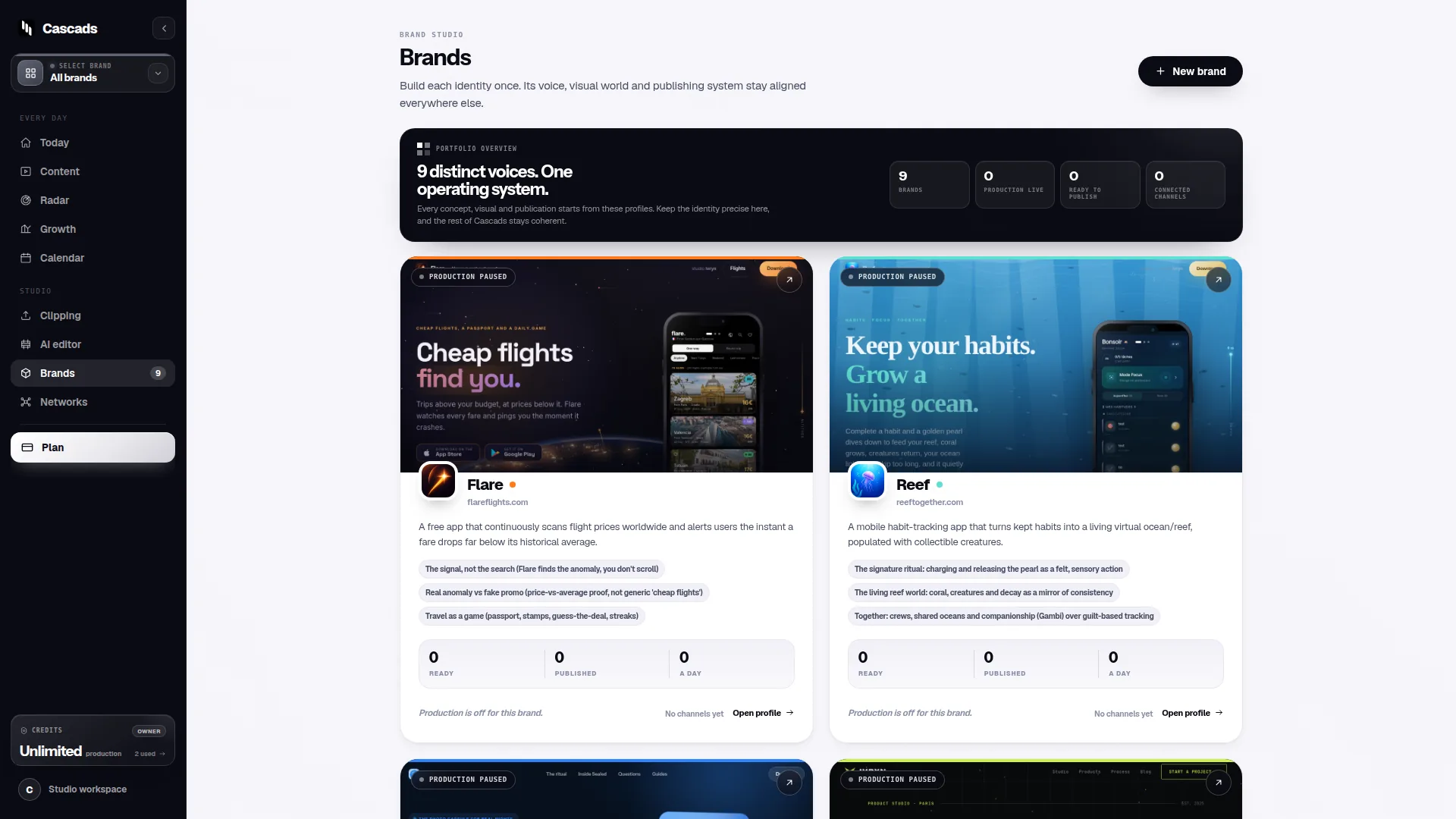
A portfolio can share a team and tools while each brand keeps a different audience, offer, voice, risk profile and publishing authority. Without explicit separation, a prompt, asset, approval or connected profile can be applied to the wrong brand. Increasing content volume then increases review load and the cost of mistakes.
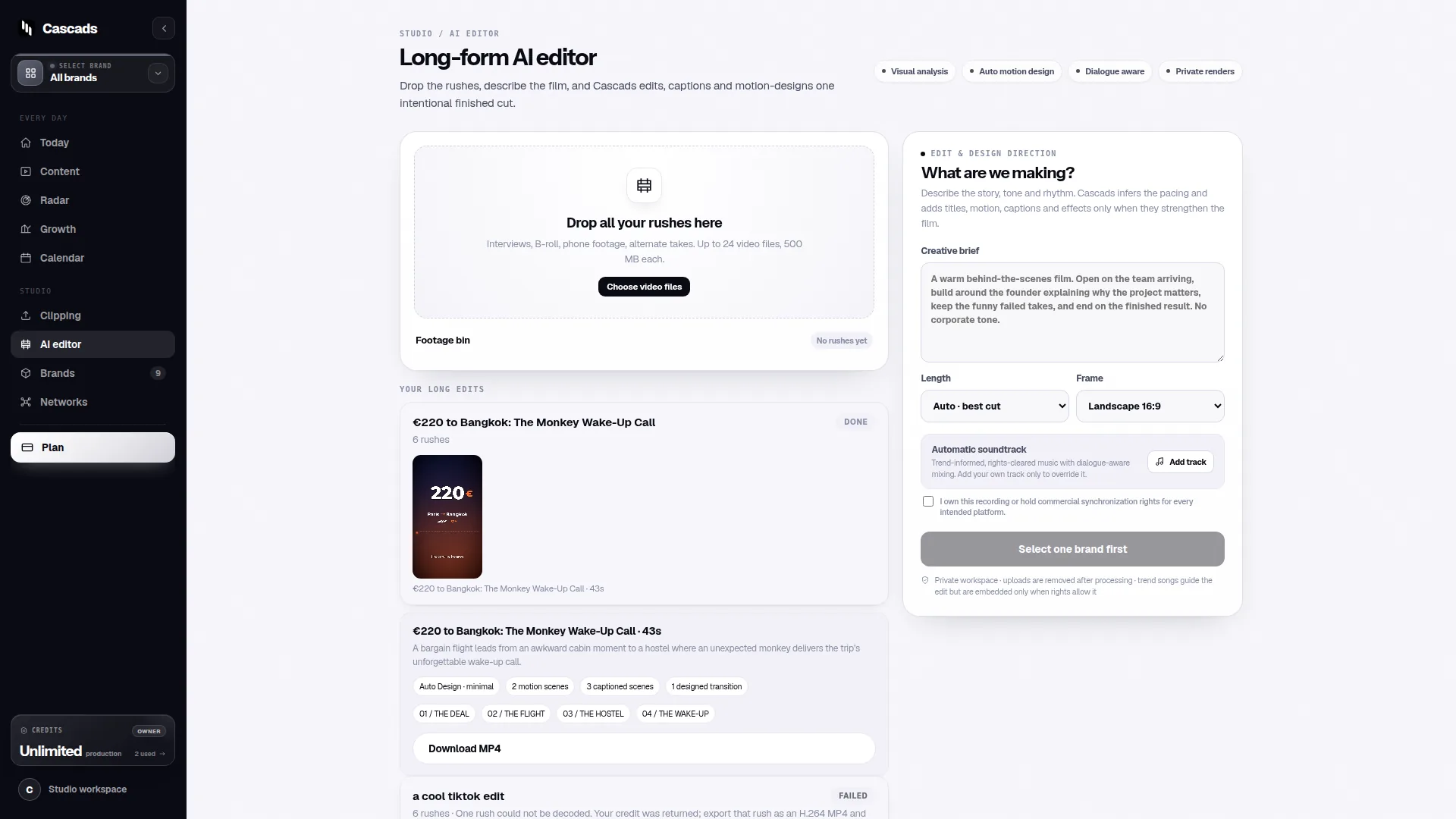
Cascads provides a social content workspace for brand profiles, generation, review and scheduling. It can bring context and decisions into one place without making brands interchangeable. Each brand still needs an owner, current sources, approved claim boundaries and network-specific rules. Portfolio visibility should preserve those differences.
Move from brand context to review, scheduling and measurement
A bounded workflow starts with a brand profile covering audience, offer, tone, prohibited claims, approved sources and networks. A brief identifies the objective and evidence instead of asking a model to invent authority. Material enters review with its brand, format, destination and claim sources visible.
Scheduling is a plan, not proof of delivery. Before an item is eligible, the workflow should verify the target account, media requirements, provider permission and the review state required by that brand. A cautious operating record should preserve the provider response and keep accepted requests, rejected requests, unresolved attempts and later-confirmed publications distinct.
Cascads documents publishing capabilities and limitations by network and media format. That documentation should be checked on a date because providers change formats, scopes and review policies. A portfolio team should route unsupported combinations to a manual or blocked path rather than silently treating all networks as equivalent.
Keep code, provider approval, account connection and real publication separate
An implemented adapter shows that code exists for a provider path. Provider approval shows that an external platform has granted a particular access level or application state. A connected account shows that a user completed the applicable consent flow and that usable credentials or permissions were recorded. None of those states, alone or together, proves that a specific post was published successfully.
Publication evidence belongs to a specific attempt and destination, such as a provider identifier, later retrieval or observable result. An error or unknown response is not success, and blind retries can create duplicates. Cascads states that publishing depends on network, format, account permissions and external approval, so missing states must block readiness.
- Implemented: a code path exists and has bounded technical tests.
- Provider-approved: the external platform granted the required application access.
- Account-connected: the intended profile has current, usable consent and permissions.
- Published: a specific delivery has provider or public evidence tied to the intended item.
Use a dated capability matrix for every network and format
A capability matrix should be specific enough to drive a decision. For each network and media format, record whether the code path is implemented, whether provider approval is verified, whether an account is connected, and which evidence confirms a real publication. Include known constraints such as aspect ratio, duration, media count, text limits, access tier and review requirements.
The matrix should not infer provider state from source code or infer a connected profile from an OAuth button. It should also avoid a single all-network status that conceals partial support. When a provider changes a policy or an account loses permission, the affected path can be blocked without disabling unrelated, verified work. Human review remains available for exceptional or high-risk brand content.
Know when a shared workspace fits and when it does not
Cascads may fit a founder, holding team or small agency managing distinct brand profiles in one reviewed workflow. Fit is stronger when each brand has an owner, approved sources and a clear review policy. The team must verify network permissions and treat platform limits as operating constraints.
It is not a fit for a team seeking a guaranteed campaign outcome, universal autopublishing or a social conversation CRM that the product does not claim to provide. It is also not ready for unattended publishing when provider approval, connected accounts or real delivery evidence are absent. In those cases, teams should keep publication manual while the unsupported automation remains blocked.
Create a review rhythm that preserves brand accountability
A weekly portfolio review can compare upcoming work, blocked items, network readiness and evidence gaps without declaring success from output volume. Brand owners can approve or reject claims, resolve conflicts and confirm the destination for each item. Operators can then inspect provider access and connected-account health. A final preflight should record the approved content version, media, account and scheduled time together.
After delivery, review confirmed publications, failures and unknown states separately. Compare performance only with consistent windows and definitions, and never present early platform metrics as guaranteed business results. Use attributable observations plus human judgment for the next decision. Automation still depends on people and external approvals.
Decision table
| Option | Works well when | Limitations | Responsibility boundary |
|---|---|---|---|
| Shared governed workspace | Several brands share operators but retain distinct context, reviewers, accounts and claim boundaries. | The workspace cannot supply missing provider approval, account consent, source evidence or business judgment. | Brand owners approve claims and destinations; operators verify network readiness; the system records workflow and delivery states. |
| Separate tool stack per brand | Brands require strong operational isolation, different teams or materially different compliance and access models. | Portfolio visibility, reusable process and cross-brand scheduling become harder, with duplicated configuration and oversight. | Each brand team owns its tools, access, reviews, provider relationships, publication evidence and measurement definitions. |
| Reviewed manual publishing | Volume is modest or an automated provider path, permission, account or media format is not verified. | Manual handoffs take time and can introduce copy, destination and evidence errors without a clear checklist. | A named operator verifies the approved asset and target, publishes it, and records the actual outcome for later review. |
Frequently asked questions
Does implemented publishing code mean a brand can publish automatically?
No. Code is one readiness layer. The external provider may require application approval, and the intended brand account must be connected with the necessary permissions. The media and text must also satisfy current provider rules. A real publication is a separate event that needs attempt-specific evidence; it should never be inferred from an adapter or test alone.
Can all brands use the same prompts and approval rules?
They can share a workflow template, but each brand needs its own audience context, approved sources, claim limits, reviewers and destination accounts. High-risk or regulated topics may require additional review. Reusing instructions without those boundaries can produce cross-brand errors. Portfolio operations should standardise the process while keeping brand facts and authority distinct.
What should a team do when delivery status is unknown?
Preserve the request and provider response, avoid marking the item as published, and use a documented reconciliation check that cannot create another post. Do not retry blindly because the first attempt may have succeeded despite an incomplete response. A human should decide the next action when evidence cannot resolve the state safely.