
Social media management kaise sikhe: where to actually start
People searching social media management kaise sikhe are usually looking for a starting point that goes beyond generic tips about posting consistently or using trending hashtags. The real skill is learning how to run a repeatable workflow: understanding a brand well enough to represent it correctly, producing content in the formats a platform actually rewards, checking that content before it goes live, and knowing that publishing itself has technical and platform-side limits that no amount of creativity can bypass.
This means the learning path has two halves. One half is creative and strategic: knowing your audience, tone, and content pillars. The other half is operational: knowing how content moves from an idea to a scheduled, approved, published post across different networks. Most beginner guides only cover the first half, which is why many new social media managers get surprised the first time a video upload fails or a client asks who approved a post.
- Learn brand fundamentals: audience, tone, and recurring themes
- Learn format literacy: what text, video, and carousel formats need
- Learn review discipline: why nothing should skip human eyes
- Learn publishing mechanics: why not everything goes live instantly
Building brand context before you build content
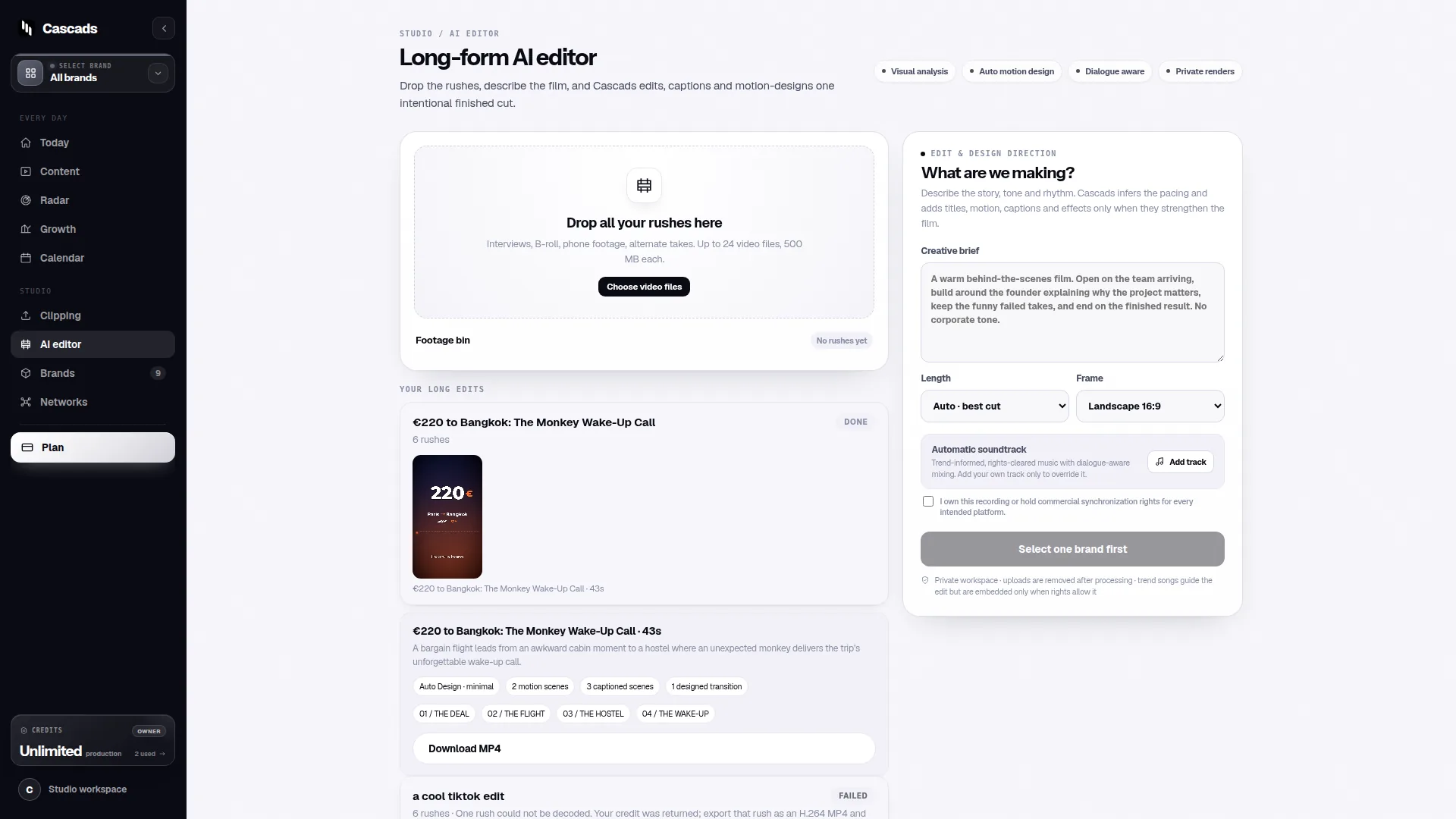
A foundational principle in social media management is that content should come from a stable, reusable understanding of the brand, not be reinvented for every post. For someone learning the discipline, this means the first real exercise isn't writing captions, it's building a brand profile: voice, audience, do's and don'ts, and recurring topics. Tools built for multi-brand teams, including Cascads, are structured around this idea, letting a team define a brand profile once and generate text posts, vertical videos, and carousels from that same reusable context rather than starting from a blank page each time.
This matters most for people managing several brands or clients at once, which is common in agencies. Without a documented brand context, quality varies post to post depending on who is writing, and mistakes creep in when someone forgets which client prefers formal language versus casual language. Learning to formalize this context early is one of the highest-leverage skills in social media management, because it protects consistency even as the person or tool producing the content changes.
Multi-format production: text, video, and carousels are not interchangeable
A second principle worth learning early is that different formats serve different purposes and have different production requirements. A text post can be drafted and adjusted quickly, but a vertical video usually needs pacing, visual sequencing, and attention to how it reads with sound off. A carousel needs a logical flow across slides, since readers may only see the first one or two before scrolling away. Someone learning social media management kaise sikhe should treat these as distinct skills, not a single 'content creation' skill.
This is also where reusable brand profiles help operationally: generating a text post, a vertical video, and a carousel from the same underlying brand context, as platforms like Cascads are designed to do, keeps the message consistent across formats even though the production steps differ. But the format itself still needs format-specific judgment. A caption that works as a text post rarely translates directly into a video script, and slide order in a carousel needs its own logic.
Beginners often assume that mastering one format means they understand social content broadly. In practice, learning to adapt the same brand message across formats, rather than treating each as isolated, is a distinct and important competency.
Why human review stays part of the workflow
Regardless of how content is produced, whether written manually or generated with assistance from a tool, a core principle to internalize is that generated marketing output should remain subject to human review before it is published. This is not a formality. Automated or templated content can misjudge tone, repeat a claim that is no longer accurate, or overlook a sensitivity specific to a brand or moment. Review is the checkpoint where those issues get caught before they reach an audience.
For someone learning social media management, this means building the habit of a review step into any workflow, even a simple one. Practically, this can look like a second person checking drafts before scheduling, or a documented approval workflow where content moves through defined stages before it's marked ready to publish.
Agencies managing multiple brands benefit from making this step explicit rather than assumed, since informal review breaks down as volume grows. Structured approval steps, as described in Cascads' guide to a social media approval workflow, are one way teams keep this checkpoint consistent even as more people and more brands are involved.
Format-aware publishing and its real-world limits
The final principle that often surprises newcomers is that publishing directly to a network is not guaranteed to work the same way every time. Whether a post can be published automatically, versus needing manual posting, depends on the specific network, the media format involved, the permissions attached to the connected account, and approval from the platform itself. This is a technical and policy reality, not a workflow choice, and it applies regardless of which tool or team is doing the publishing.
Someone learning social media management should treat this as a core piece of literacy, not an edge case. A vertical video might publish smoothly to one network but require extra account permissions on another. A carousel format might not be supported at all on a given platform. Understanding this in advance prevents the common beginner mistake of promising a client or manager that 'everything will be automated,' when in practice some formats or networks will always require manual steps or additional account setup.
Resources such as Cascads' publishing integration checklist illustrate the kind of variables worth checking before assuming a publishing pipeline will work end to end: account permissions, supported formats per network, and platform-side approval requirements.
A worked example: mapping a week's content plan
Example only, not a real case: imagine a small agency managing two brands, each posting three times a week across one video-first network and one text-first network. A person learning social media management might sketch it like this: Monday's brand profile review confirms tone and any new campaign notes; Tuesday, drafts are produced in each needed format from that brand profile; Wednesday, a second team member reviews all drafts against brand guidelines and factual accuracy; Thursday, the team checks which posts can be scheduled directly per network and which need manual publishing due to format or permission limits; Friday is a buffer day for platform-side approval delays.
This kind of mapping exercise is useful precisely because it forces a beginner to separate the four principles: brand context (Monday), multi-format production (Tuesday), human review (Wednesday), and format-aware publishing limits (Thursday-Friday). Doing this exercise with your own real brands, even roughly, is a more durable way to learn than reading about workflow theory alone.
- Monday: confirm brand context and any campaign updates
- Tuesday: produce drafts in each required format
- Wednesday: human review against brand guidelines
- Thursday: check per-network publishing eligibility
- Friday: buffer for platform approval delays
Frequently asked questions
Is there a fixed course or certification needed to learn social media management?
There is no single required course; what matters more is building a repeatable workflow covering brand context, format-specific production, human review, and awareness of platform publishing limits, which can be learned through practice and structured guides rather than one certification.
Can social media posting be fully automated once content is created?
Not always. Whether a post can publish directly depends on the network, the media format, the account's permissions, and platform-side approval, so some posts will still require manual steps regardless of how the content was produced.
Why does human review matter if content is already following brand guidelines?
Guidelines don't catch every issue, since tone misjudgments, outdated claims, or context-specific sensitivities can still appear in a draft, so a human review step before publishing remains an important safeguard even for well-defined brand content.
Sources and further reading
These resources provide the wider reference frame. Product statements on this page are limited to the public information provided by Cascads.