What social media management for small business actually requires
Social media management for small business is not the same job as it is at a large company with a dedicated marketing department. A small business owner or a single generalist employee is usually doing this work alongside sales, operations, or customer service, with an hour or two a week rather than a full-time role. That constraint shapes everything: the goal is not to run every channel perfectly, it is to run a small number of channels consistently without the process collapsing the first time someone gets busy.
The core requirement is a repeatable workflow, not a long list of tactics. A workflow that depends on remembering brand voice, image sizes, and posting rules from scratch each time will break down under time pressure. A workflow built around a reusable brand profile, a small content library, and a simple review step before anything goes live is far more resilient, because it removes recurring decisions rather than adding more advice to follow.
It also requires realistic expectations about publishing itself. Even with good planning, whether a post can be scheduled and published directly to a given network depends on the network, the media format involved, and the permissions granted on that account, plus approval from the platform itself. Any small business plan should account for that variability rather than assume every post will go out identically everywhere.
Start with a brand profile, not a content calendar
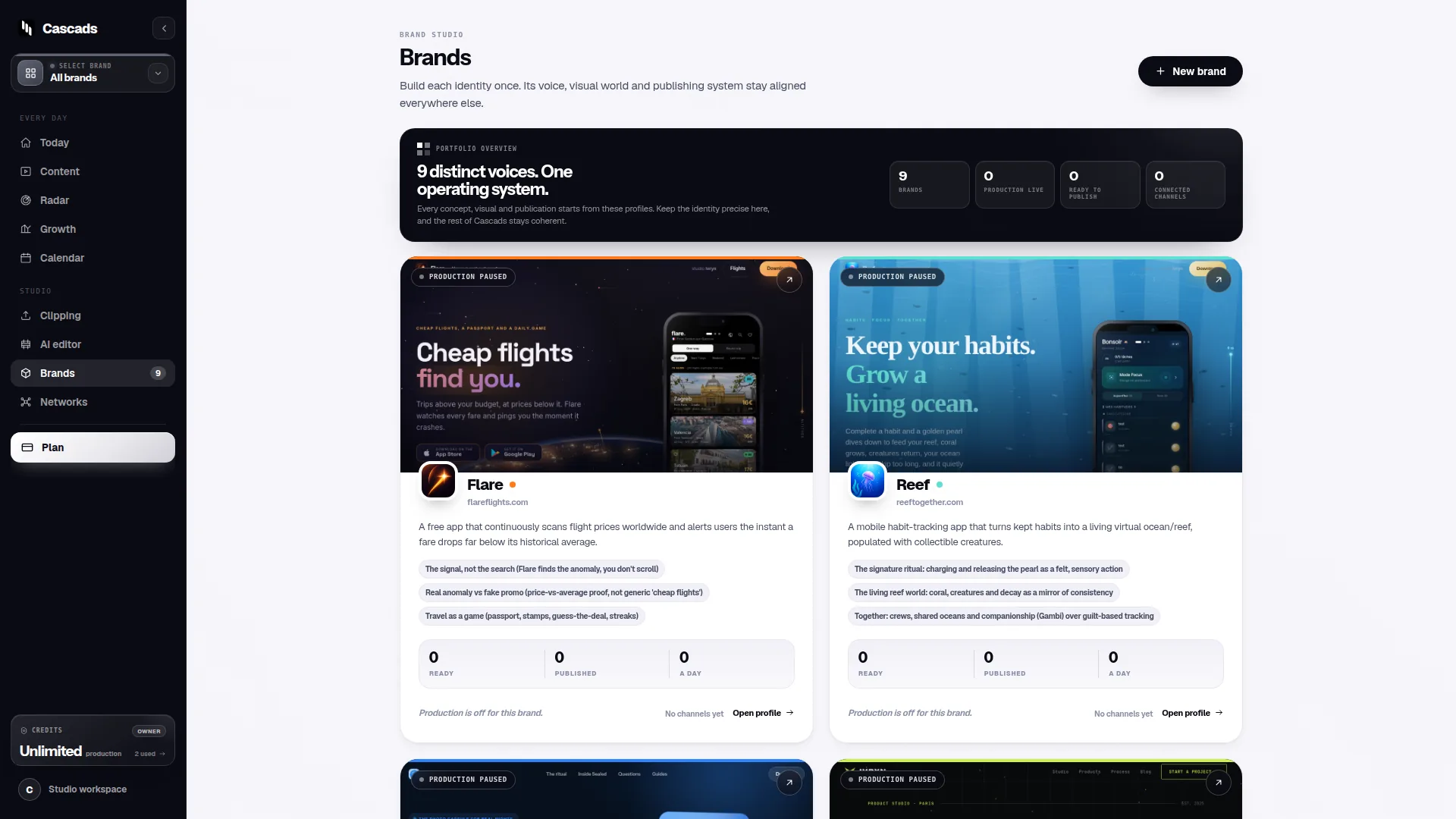
Most small business guidance jumps straight to a content calendar. In practice, the calendar is the easy part; the hard part is producing content that consistently sounds like the business without someone rewriting it every time. This is where a defined brand profile matters more than a scheduling grid: a short, reusable reference covering tone, key messages, visual style, and the handful of topics the business actually wants to be known for.
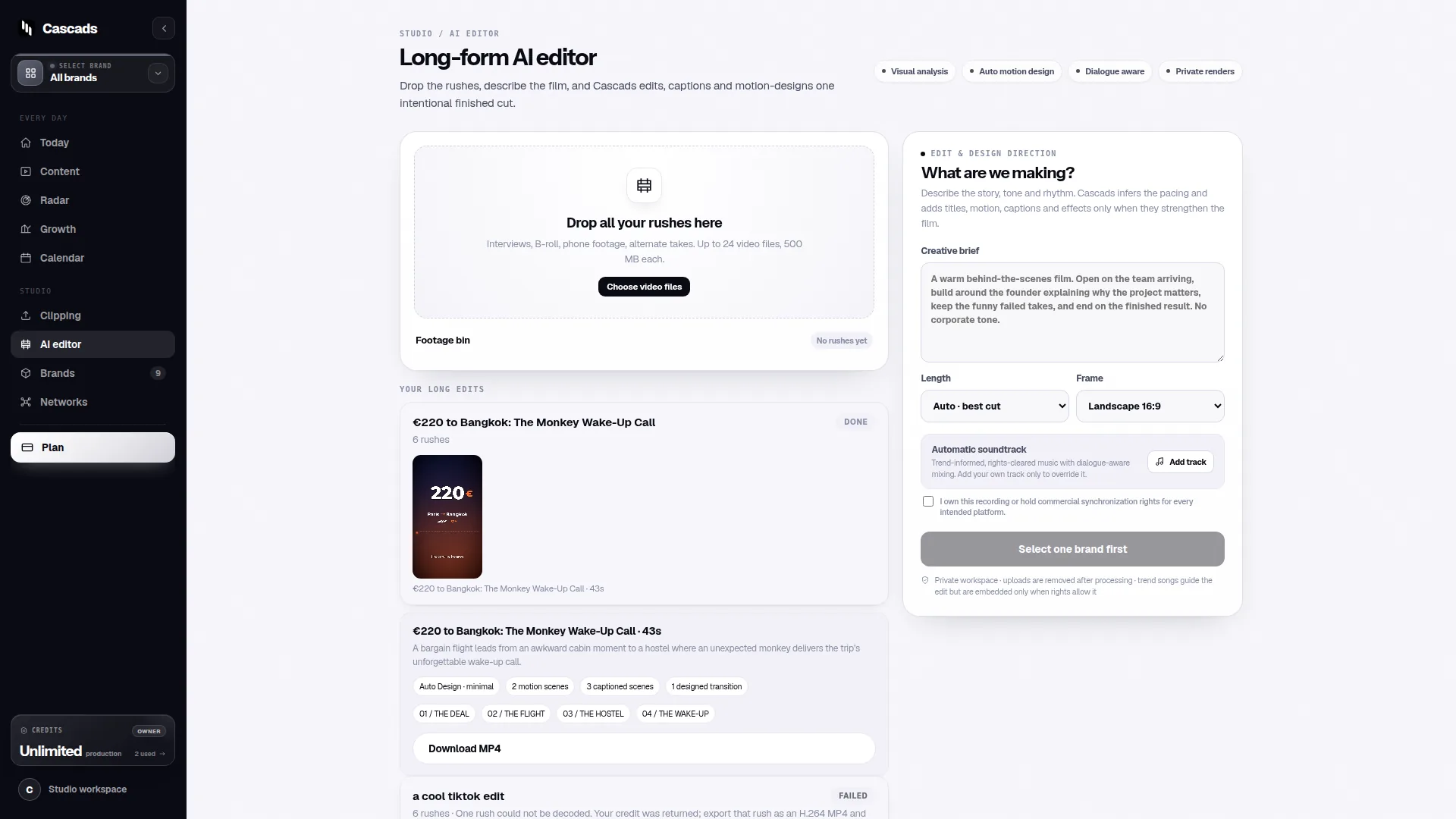
Cascads is built around this idea for agencies and small teams managing several brands. It generates text posts, vertical videos, and carousels from a reusable profile set up once per brand, rather than starting each piece of content from a blank page. That is a useful pattern to borrow even outside the product: define the profile first, then treat every post as an application of that profile rather than a fresh creative decision.
For a solo operator or a two-person team, the profile can be simple: a paragraph on voice, three or four recurring content themes, and a short list of formats the business actually uses (for example, product photos, short vertical video, and simple carousels). The value is in having something written down that a busy person can apply quickly, not in the sophistication of the document.
Multi-format production without a design team
Small businesses are increasingly expected to show up in text posts, short vertical video, and carousel formats, because different networks and different audience segments respond to different formats. Producing all three by hand, with no design or video staff, is where most limited-hours social media efforts stall out, since each format traditionally needed a different skill and a different tool.
The practical fix is to standardize inputs rather than outputs. If the brand profile defines consistent visual elements and messaging, the same underlying content idea can be adapted into a caption, a short video script, or a carousel sequence with much less manual rework. Tools built for this, including Cascads, are designed to generate these formats from one profile, which reduces the production burden without requiring the business to hire specialist staff.
This does not remove the need for judgment. A format that performs well on one network is not automatically right for another, and a small business should still decide deliberately which formats suit its actual products and audience rather than producing every format for its own sake just because a tool makes it possible.
- Pick two or three formats the business can sustain, not every format available
- Reuse the same core message across formats instead of writing separate ideas for each
- Revisit format choices periodically as the business and audience change
Human review is not optional
Whatever process a small business uses, generated marketing content should be reviewed by a person before it publishes. This matters more, not less, when time is limited, because a rushed post that misrepresents a promotion, uses an outdated price, or misstates a policy can cost more time to fix than it saved to produce.
A workable review step does not need to be elaborate. It can be a five-minute pass by the owner or one designated staff member before anything is scheduled: checking that facts are current, that the tone matches the brand, and that nothing in the post could be misread. The point is that a review step exists and is actually followed, not that it is exhaustive.
This is also where small teams should be honest about scope. If review capacity is genuinely one person for fifteen minutes a week, the realistic content volume is lower than what a full calendar would suggest. It is better to publish less and review everything than to publish more and skip review under pressure.
Format-aware publishing and platform limits
One of the more overlooked parts of social media management for small business is that scheduling a post and having it actually publish are two different things. Direct publishing to a network depends on the network itself, the media format being posted, the permissions attached to the connected account, and approval from the external platform. A small business relying on scheduled publishing should build in a check that content actually went live, rather than assuming a scheduled post is a published post.
This is not a flaw specific to any one tool; it reflects how social platforms operate their own APIs and approval processes, which change over time and are outside any content tool's control. A sensible small business workflow treats platform publishing as something to verify periodically, particularly for newer formats like vertical video or carousels where permission requirements can be more involved than a simple text post.
Building this awareness into the weekly routine, even as a quick end-of-week check that recent posts appeared where expected, prevents the common failure mode where a business believes it has been posting consistently when in fact several posts silently failed to go through.
A worked example: a two-person small business, three hours a week
This example is illustrative only and does not reflect a documented case, customer, or result. Consider a small local retail business with two staff sharing marketing duties, with a combined three hours a week for social media across two networks.
In this hypothetical, the first hour is spent once per quarter refreshing the brand profile: updating seasonal messaging, current promotions, and any new products, so the reference stays accurate rather than stale. Each week, roughly one hour goes to producing a small batch of content from that profile, drafting a mix of text posts and one short video or carousel rather than a large volume across every possible format. The remaining time is split between a quick human review of everything before it is scheduled and a short check at the end of the week that recently scheduled posts actually published, since permissions or format issues can occasionally block a post from going live.
The point of this hypothetical is not the exact numbers, which will vary by business, but the shape of the routine: a stable brand reference, a modest and sustainable production batch, a real review step, and a habit of confirming publication rather than assuming it. A small business adapting this shape to its own hours and networks is likely to end up with a more durable process than one built around a long list of unrelated tactics.
- Quarterly: refresh the brand profile
- Weekly: produce a small, sustainable batch of content in the formats you can support
- Before scheduling: a short human review pass
- End of week: confirm scheduled posts actually published
Frequently asked questions
How much time does social media management realistically take for a small business?
It depends heavily on how many networks and formats the business supports, but a small business with no dedicated staff can maintain a modest, sustainable presence with a few focused hours a week if it relies on a consistent brand reference and a small, repeatable content batch rather than trying to cover every format and network at once.
Should a small business skip human review to save time?
No. Generated or scheduled marketing content should still be reviewed by a person before it publishes, since a quick check for accuracy and tone is far cheaper than correcting a public mistake, and this holds true regardless of which tool or process produced the content.
Why does a scheduled post sometimes not appear on a platform?
Direct publishing to a social network depends on the network itself, the media format of the post, the permissions granted to the connected account, and approval from the external platform, so a scheduled post can occasionally fail to go live for reasons outside a business's content process; checking that posts actually published is a useful habit.
Sources and further reading
These resources provide the wider reference frame. Product statements on this page are limited to the public information provided by Cascads.