Why social media management west yorkshire searches lead to different answers than expected
Anyone researching social media management west yorkshire is usually looking for one of two things: a local agency to hand the work to, or a clearer sense of how the underlying workflow actually functions so they can judge whether outsourcing, hiring, or using software makes sense. The phrase itself doesn't distinguish between these, which is why search results tend to mix directory-style agency listings with generic 'what is social media management' explainers.
The more useful starting point is to separate the geography from the mechanics. Location matters for things like understanding local business context, time zones for posting schedules, or wanting a supplier who can meet in person. It matters much less for the actual technical and editorial questions: how content gets created consistently across brands, how it gets approved before it goes live, and how it actually reaches each platform. Those mechanics are the same whether the team sits in Leeds, Bradford, Huddersfield, or works remotely.
This article focuses on the mechanics, because that's where most of the real decisions and real limits live. A West Yorkshire-based team producing content for several client brands or several of their own brand accounts faces the same production and publishing constraints as a team anywhere else.
Brand context is the foundation, not an afterthought
A recurring failure point in social content work, particularly for agencies or small teams handling more than one brand, is treating each post as a standalone creative task rather than an output of a defined brand profile. Without a consistent reference point covering tone, visual style, audience, and permitted claims, output quality drifts as different people (or different sessions of the same person) produce content over weeks and months.
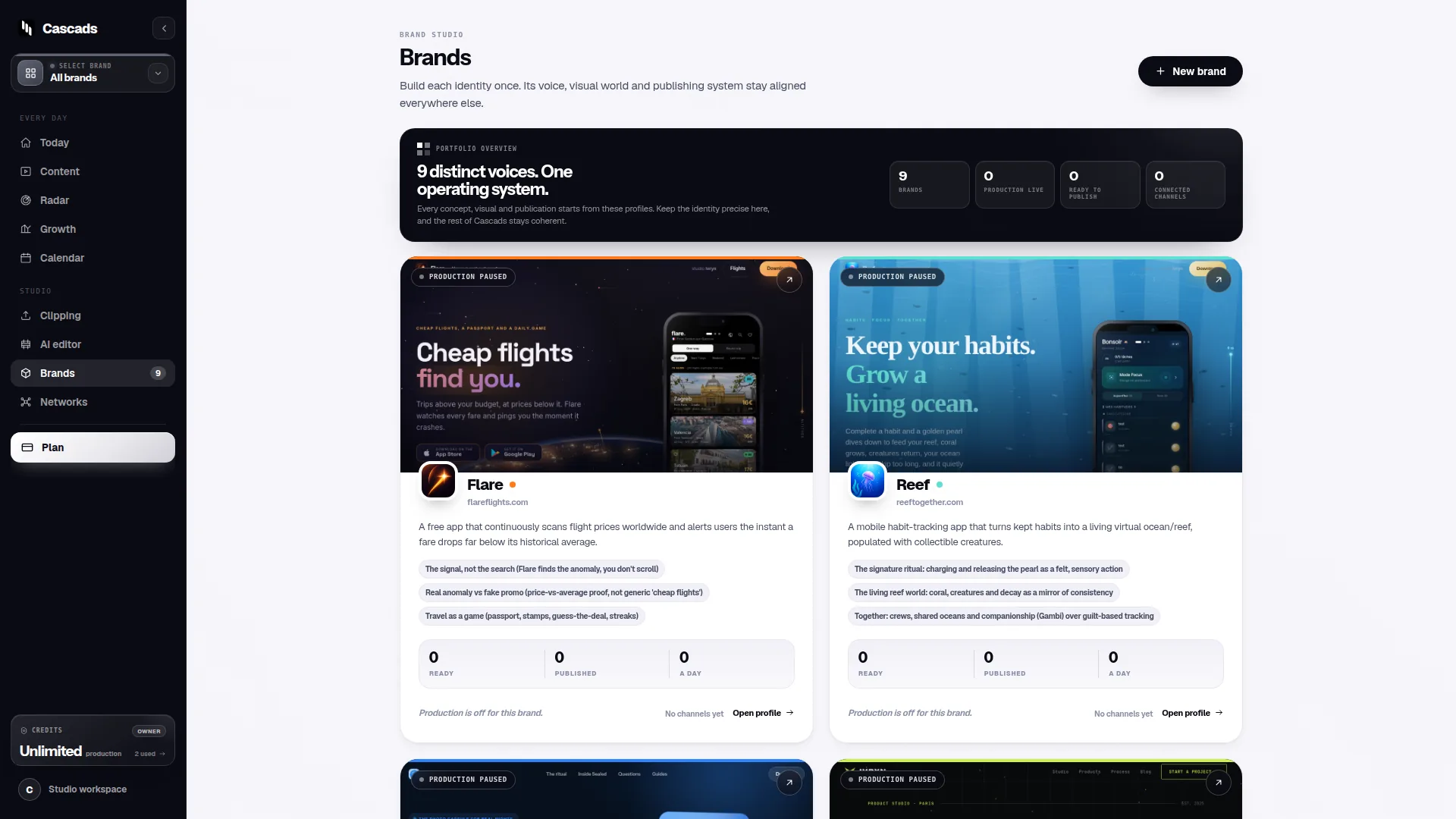
Cascads, an IVRYN product built for social content production and scheduling, approaches this by working from a reusable profile per brand rather than starting from a blank page each time. In practice that means the brand's context is set once and referenced repeatedly, rather than re-explained or re-guessed for every piece of content. For a team managing several client brands, this kind of structure is less about convenience and more about consistency: it reduces the chance that one brand's content quietly starts sounding like another's.
Whether a team builds this discipline manually with shared documents and templates, or uses a tool that encodes it, the underlying principle is the same: content quality across a multi-brand workload depends on having a stable reference for each brand, not on individual effort alone.
Multi-format production and why it changes the workload
Social content today rarely means a single format. A realistic brief usually spans short text posts, vertical video, and carousel-style image sequences, each with different production requirements and different platform expectations. Teams researching social media management west yorkshire are often really asking how to sustain output across all three without tripling their workload.
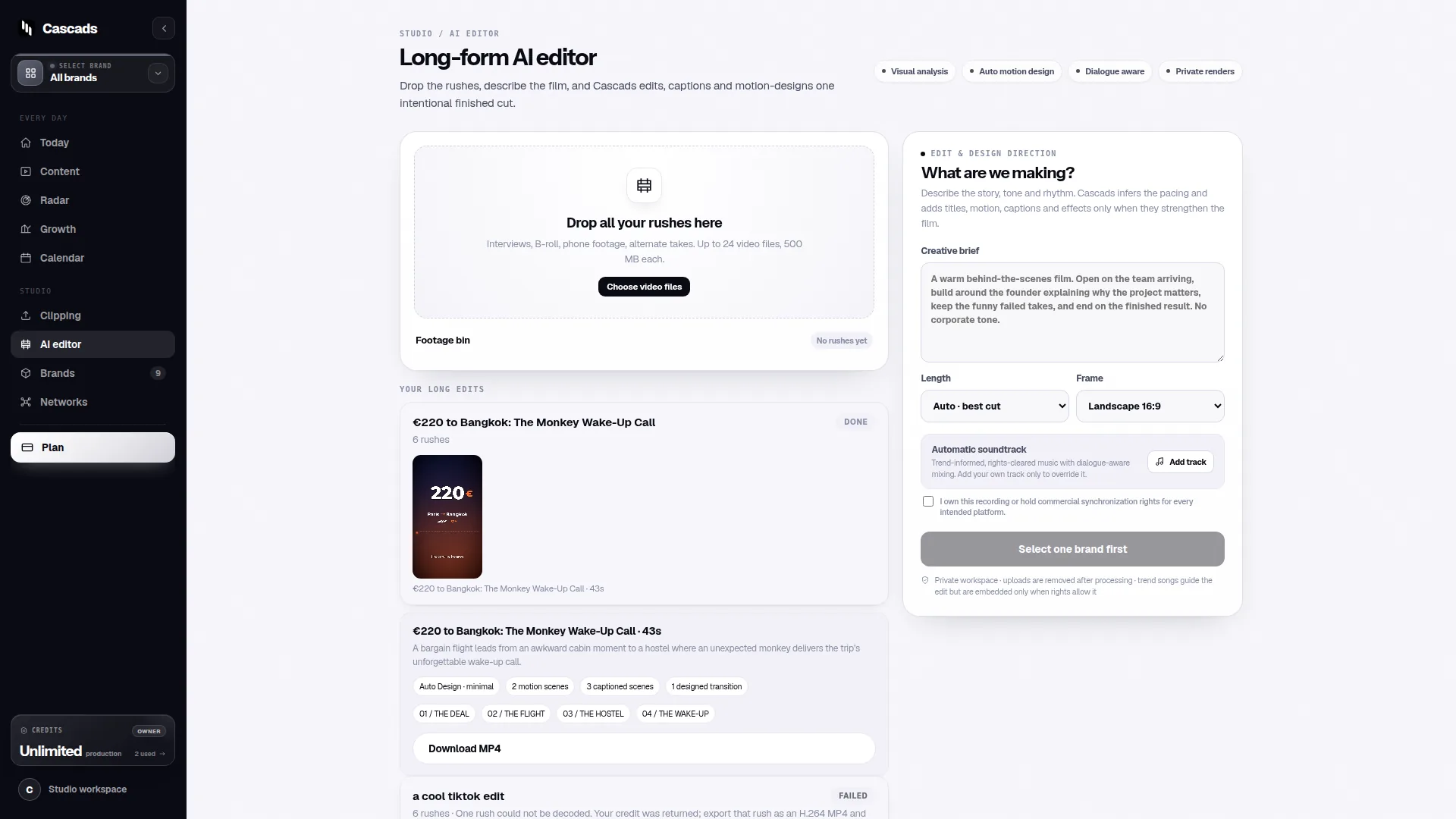
This is a structural reason format-aware tools matter: producing a script for a vertical video is a different task from writing a text caption, and slicing a carousel into readable panels is different again. Cascads generates text posts, vertical videos, and carousels from the same underlying brand profile, which is one way of keeping multiple formats aligned without treating each format as a separate project with its own brief.
That said, format range doesn't remove the need for judgment. A vertical video intended for one platform's short-form feed may need reworking, not just resizing, before it fits another platform's expectations. Teams should budget time for format-specific adjustment rather than assuming one generated asset works everywhere unchanged.
Human review is a limit, not an optional extra
One of the clearest constraints in this space, and one worth stating plainly: generated marketing output, regardless of the tool producing it, remains subject to human review before publication. This isn't a caveat added for legal comfort; it reflects a genuine limit of automated content generation, which can produce factually wrong claims, tone mismatches, or brand inconsistencies that only a human reviewer reliably catches.
For a small team or agency handling several client accounts, this has a direct staffing implication: someone needs to be accountable for reviewing content before it goes live, and that responsibility doesn't disappear because production became faster or more automated. Cascads' own approach to this, described in its approval workflow guidance, is to build a review step into the process rather than treat it as a manual bolt-on after the fact.
Worked example (illustrative, not a claim about outcomes): imagine a three-person agency team in West Yorkshire managing social accounts for five local business clients. If content generation takes an afternoon per week per client, but review and approval are skipped or rushed, the team saves time upfront and risks an inaccurate claim or off-brand post reaching a client's audience. Building in even a short, defined review checkpoint per client per week costs time but directly addresses that risk. The trade-off is between speed and the cost of catching a bad post before it's public, not after.
Publishing limits: what varies by network and format
This is the section most likely to be skipped by teams new to multi-brand social work, and it's where a lot of avoidable frustration comes from. Direct publishing from any production tool, Cascads included, depends on the specific network, the media format involved, the account's granted permissions, and whether the external platform has approved the relevant integration or API access.
Practically, this means a workflow that publishes smoothly to one platform may require an extra manual step for another, not because the tool failed, but because platform-level permissions or approval status differ. Teams should check, account by account, what direct publishing is actually available before building a schedule that assumes uniform automation across every network.
Cascads' publishing integration checklist is a useful reference point for working through this systematically rather than discovering gaps mid-campaign. The core habit worth adopting: verify publishing capability per network and format before committing a client or brand schedule to it, rather than assuming parity across platforms.
A simple decision checklist for evaluating a social media management approach
For a West Yorkshire-based team weighing whether to hire locally, build an in-house process, or adopt a production tool, the geography rarely changes the decision criteria. The following checklist is meant as a practical starting point for that evaluation, not a ranking of options.
Each item below reflects one of the constraints already discussed: brand consistency, format range, review responsibility, and publishing variability. Working through them honestly, ideally with real client or account numbers in mind, gives a clearer picture than comparing feature lists alone.
- How many brands or client accounts need distinct, consistent tone and style, and how is that consistency currently maintained?
- What mix of text, video, and carousel content does the workload actually require, and how much manual rework does each format currently need?
- Who is responsible for reviewing generated or drafted content before it publishes, and is that review step actually happening every time?
- For each network in use, has publishing capability (direct vs. manual) actually been checked per account, rather than assumed?
- What is the real cost, in time or risk, of a review step being skipped versus the time it takes to do properly?
Frequently asked questions
Does using a production tool remove the need for someone to review social posts before they go live?
No. Generated marketing content, regardless of the tool used to produce it, still needs human review before publication, since automated generation can produce factually incorrect or off-brand output that only a reviewer is likely to catch.
Can all social content be published directly to every platform automatically?
Not reliably. Direct publishing depends on the specific network, the media format, the account's granted permissions, and whether the platform has approved the relevant integration, so capability should be checked per account and per network rather than assumed.
Is location, such as being based in West Yorkshire, a meaningful factor in choosing a social media management approach?
Location mainly affects things like finding a locally based agency or team; the underlying production, review, and platform-publishing constraints are the same regardless of where a team is based.
Sources and further reading
These resources provide the wider reference frame. Product statements on this page are limited to the public information provided by Cascads.