Why is a social media manager important: the short answer
Why is a social media manager important comes down to one recurring problem for small teams and agencies: content that looks fine in isolation but drifts once it's produced across several brands, networks, and people. A social media manager is the person (or, increasingly, the person plus a workflow) who keeps a brand's voice, claims, and publishing rules consistent even as volume increases. Without that role, teams tend to lose track of which account a post is for, what tone it should carry, and whether it has actually been checked before it goes live.
This matters more as production scales. A single founder posting occasionally can hold all the context in their head. A team running five client accounts across text, video, and carousel formats cannot. The social media manager function - whether it's a job title, a shared responsibility, or a workflow supported by software - exists to carry that context reliably from one post to the next.
Brand context is the thing that gets lost first
The most common failure mode in multi-brand social production isn't a bad post - it's a post that's fine on its own but wrong for the brand it's attached to. Wrong tone, wrong claims, wrong visual style, or a call-to-action that doesn't match the brand's actual offer. This happens because context (who the brand is, what it can credibly say, what it has already promised) doesn't travel automatically between people or tools.
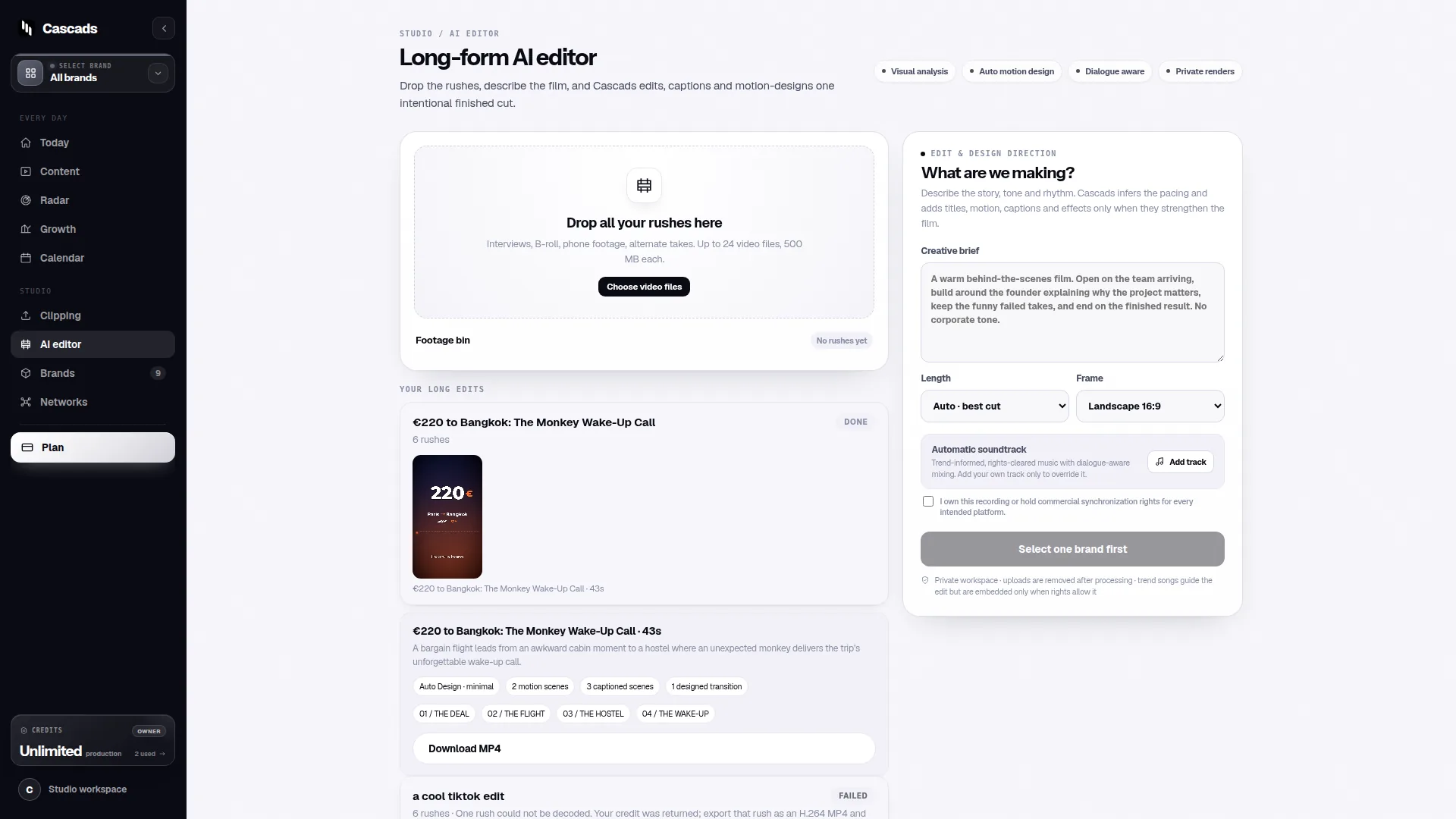
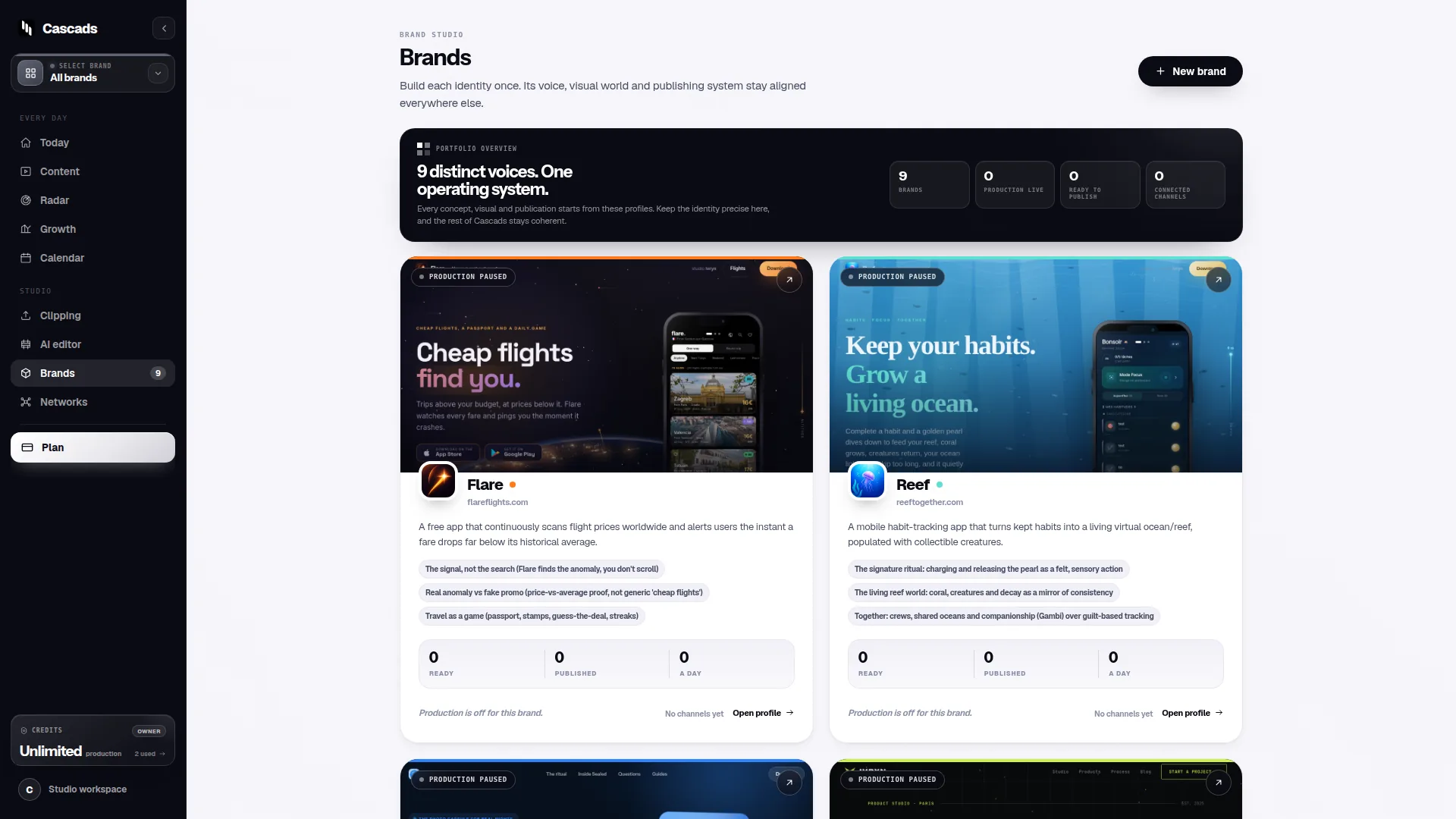
A social media manager's core job is to hold that context and apply it consistently. In practice this looks like a reusable reference for each brand: its voice, its approved claims, its visual guardrails. Cascads, an IVRYN product for social content production and scheduling, approaches this by letting a brand's context live in a reusable profile that generates text posts, vertical videos, and carousels from the same starting point, rather than reconstructing brand voice from scratch each time a post is drafted. That's a description of how the product is structured, not a claim about outcomes - the value still depends on the profile being set up carefully and kept current.
For a reader evaluating any tool or process claiming to solve this, the test is simple: does the brand's context sit in one place that everyone drafting content actually references, or does it live in someone's memory and old post examples?
Multi-format production adds a layer most people underestimate
A second reason a social media manager is important: modern social content isn't one format. Text posts, vertical video, and carousels each carry different constraints - different pacing, different visual rules, different reading behavior. A message that works as a caption doesn't automatically work as a script, and a carousel that explains something in six slides can't just be trimmed into a single post.
This is where a social media manager (or a workflow built to support that function) earns its keep: translating one message into multiple formats without losing the point or introducing inconsistency between them. It's tempting to treat this as pure production speed, but the harder part is judgment - deciding which format actually suits the message, not just producing all three because a tool makes it possible.
Teams that skip this step often end up with format-shaped content instead of message-shaped content: a video that exists because video was easy to generate, not because video was the right choice for that particular idea.
Human review is not optional, and here's why
Whatever produces the first draft of a post - a person, a template, or a generation tool - the output still needs a human check before it goes to a public audience. This is true independent of how the draft was made. Claims need verifying, tone needs a sanity check against the brand and the moment, and legal or reputational risk needs a second set of eyes.
This is one of the clearest reasons the social media manager role (or an explicit review step standing in for it) matters: it's the checkpoint that catches a post before it becomes a public, hard-to-retract mistake. Any generated marketing output, regardless of the tool that produced it, remains subject to human review before publication - that's a constraint on the process, not an optional best practice.
For teams running several brands at once, this review step tends to be the first thing skipped under time pressure, which is exactly when it matters most. A structured approval workflow - who reviews what, in what order, before what deadline - is the practical way to keep that from happening. Cascads' own guide to a social media approval workflow at https://cascads.com/guides/social-media-approval-workflow/ describes one way to structure that checkpoint, though the specifics of any workflow should be adapted to a given team's risk tolerance and account structure.
Format-aware publishing: why the network decides more than the plan
A social media manager also needs to understand that publishing itself isn't uniform across platforms. Whether a piece of content can be posted directly, and in what form, depends on the network, the media format, the account's permissions, and whether the platform has approved the publishing method being used. This isn't a detail to gloss over - it's often the difference between a campaign that runs on schedule and one that stalls because a format wasn't actually publishable the way it was planned.
This is a genuinely underappreciated part of why the role matters: a plan that ignores platform-level publishing constraints will eventually collide with them, usually at an inconvenient moment. Cascads' publishing integration checklist at https://cascads.com/guides/social-media-publishing-integration-checklist/ lays out the kind of account- and format-level checks worth confirming before treating a publishing plan as reliable - which network, which format, which permissions, and whether platform approval is in place.
A social media manager who checks these constraints ahead of time avoids the scramble of discovering, mid-campaign, that a given format can't actually be published the way the plan assumed.
Worked example: a two-brand agency week
Here's a hypothetical, illustrative only, to show how these principles connect in practice. An agency manages two brands - a coffee subscription and a bookkeeping service - and plans one carousel, one vertical video, and two text posts per brand this week.
Example walkthrough:
- Brand context check: the coffee brand's profile flags a casual, playful tone; the bookkeeping brand's profile flags a precise, reassuring tone. Drafts for each are checked against their respective profile before anything moves forward.
- Format decision: the bookkeeping brand's message this week (a tax-deadline reminder) is decided to work better as a text post and carousel than as video, since the content is detail-heavy and better read than watched.
- Human review: both brands' drafts go through a named reviewer before scheduling, per the agency's approval workflow, catching one factual overstatement in the bookkeeping carousel before it's fixed.
- Publishing check: the coffee brand's vertical video is confirmed as postable directly to its connected account, given that network's current permissions and approval status for that account and format; the bookkeeping post's carousel format is confirmed separately since carousel support can differ by network and account.
This is an illustration of the workflow, not a report of an actual campaign or its results.
A practical checklist for evaluating your own setup
Whether or not a team has someone with the title 'social media manager,' the underlying function needs to happen somewhere. This checklist is a starting point for auditing whether it's happening well.
Ask, for each brand you produce content for:
- Is there one clear reference for this brand's voice, claims, and visual style that everyone drafting content actually uses?
- When a message is produced in multiple formats (text, video, carousel), is the format chosen because it suits the message, not just because it's available?
- Does every piece of content pass a named human reviewer before it's scheduled or published?
- Has publishing eligibility - network, format, account permissions, platform approval - been checked before the content is treated as ready to go live?
- If the answer to any of these is 'it depends on who's working that day,' that's the gap the social media manager function is meant to close.
Frequently asked questions
Is a social media manager still necessary if a team uses content generation software?
Yes. Generation tools can speed up drafting across formats, but they don't replace the judgment involved in checking brand fit, choosing the right format for a message, and reviewing content before it's published - that function still needs a person, whether or not it has a formal job title.
What's the biggest risk of not having a clear social media manager function?
Content drift: posts that individually seem fine but collectively lose brand consistency, or worse, unreviewed claims and errors reaching a public audience because no one was clearly responsible for the check before publishing.
Does having a social media manager guarantee a post can be published directly to every platform?
No. Direct publishing depends on the network, the media format, the account's permissions, and platform approval - a social media manager's job is to check these constraints ahead of time, not to override them.
Sources and further reading
These resources provide the wider reference frame. Product statements on this page are limited to the public information provided by Cascads.