What people usually mean by a social media management virtual assistant
When small teams and agencies search for a social media management virtual assistant, they are rarely picturing a literal person. Most are looking for software that takes over the repetitive parts of content production: drafting posts, adapting them across formats, and getting them into a scheduling queue without someone starting from a blank page every time. The term is a shorthand for 'something that reduces manual work,' not a promise of full autonomy.
That distinction matters because the phrase invites two different expectations. One is a tool that assists a human who still makes the final calls. The other is a system that acts independently on a brand's behalf, publishing without oversight. Almost every credible product in this space, including Cascads, falls into the first category, and understanding why is the first thing worth knowing before evaluating any option.
Why brand context changes what 'assistant' can safely do
A social media assistant is only useful if it understands the brand it is working for, not just the topic of a post. Voice, visual style, past campaigns and audience expectations differ enough between brands that generic content generation quickly becomes a liability rather than a time-saver, especially for agencies juggling several clients at once.
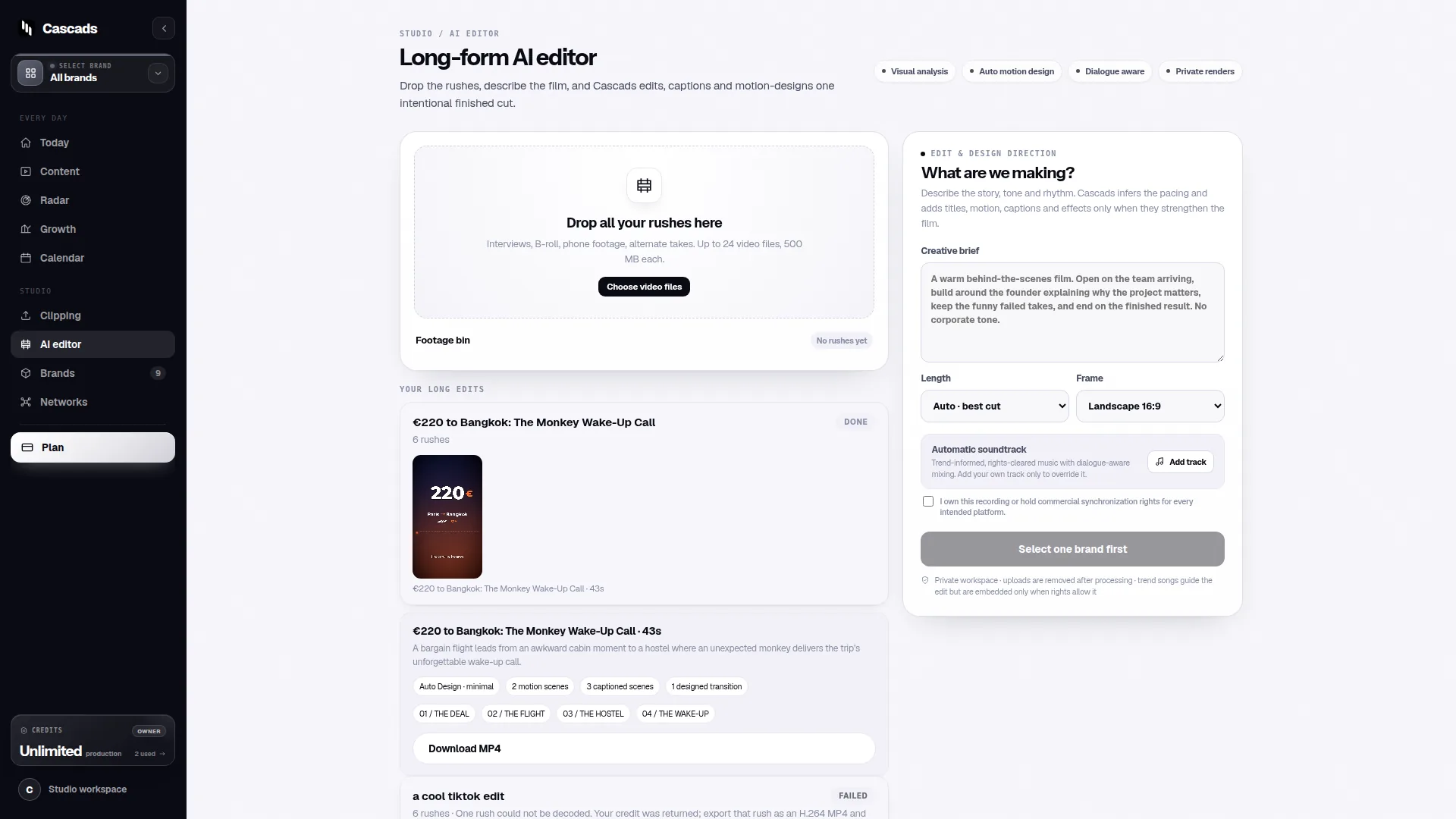
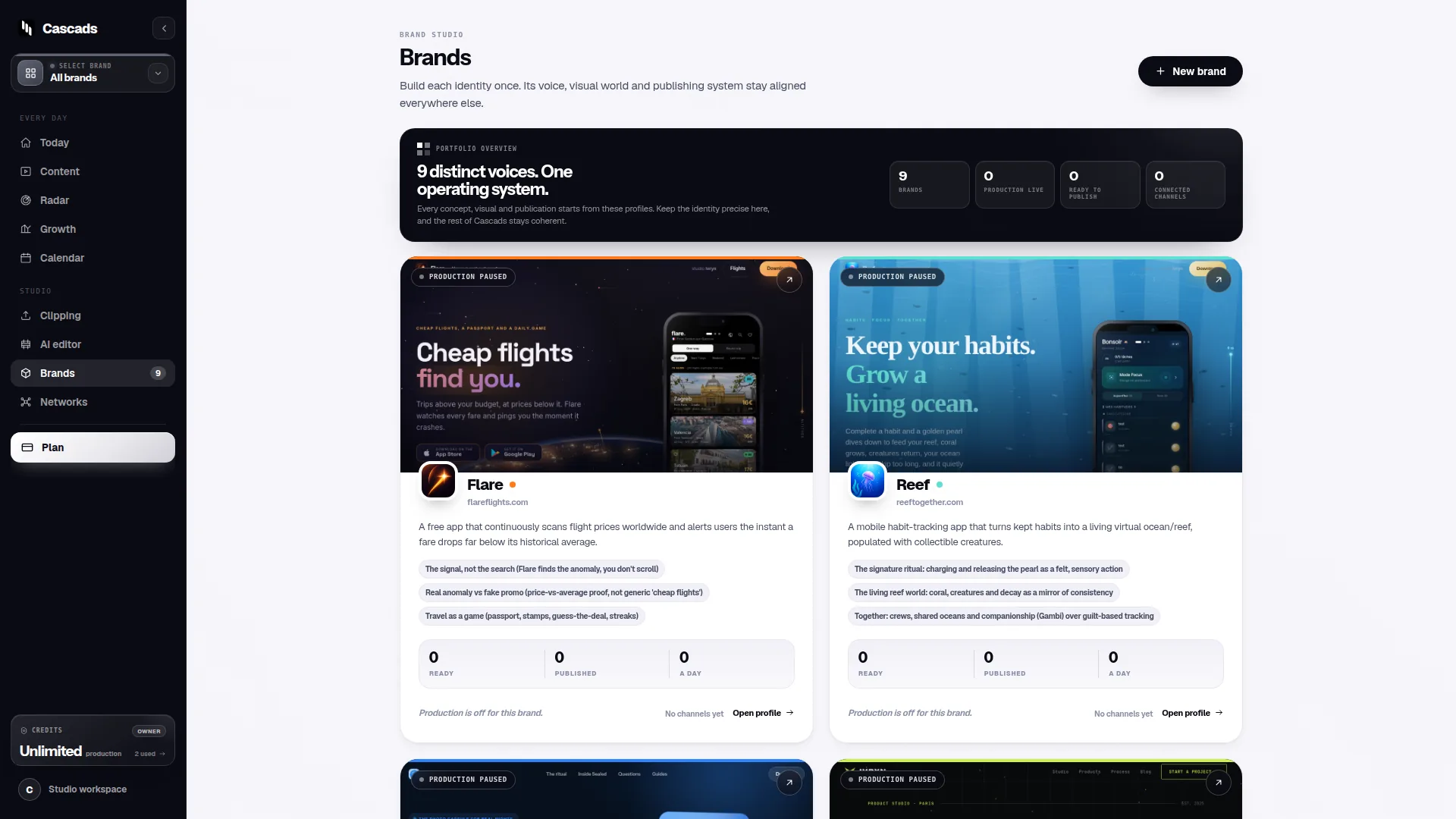
This is where a reusable brand profile earns its place in the workflow. Cascads, for example, is built around the idea that a brand's context is set up once and then reused to produce text posts, vertical videos and carousels, rather than re-briefed for every single piece of content. That reduces repetitive setup work, but it does not remove the need for someone to check that the profile itself stays accurate as a brand evolves.
Agencies in particular should treat the brand profile as a living asset. If a client rebrands, shifts tone, or launches a new product line, the profile needs updating before new content is generated from it. Skipping that step is a common way generic-sounding content sneaks past review.
Multi-format production and why it doesn't shortcut approval
One practical benefit of tools built for this purpose is producing several formats from a single brand profile: a text post, a short vertical video, a carousel. For a small team covering multiple networks, that can meaningfully cut the time spent reformatting the same idea by hand.
It's worth being clear-eyed about what multi-format production does not solve. Each format carries its own risks: a carousel might misstate a claim across several slides, a video script might include a tone mismatch that a static post would not have. More outputs mean more surface area to review, not less need for review overall.
A useful mental model is to treat format count as a multiplier on review time, not a replacement for it. Teams that assume 'more formats generated' equals 'less human work' tend to be the ones caught off guard when something inaccurate or off-brand reaches a live account.
Human review is the boundary, not an optional extra
Every credible social media management virtual assistant, Cascads included, treats generated marketing content as a draft that a person reviews before it goes live. This isn't a limitation to work around; it is the mechanism that keeps automated production usable at scale without repeated mistakes reaching an audience.
Cascads' own approach documents this as a review step built into the workflow rather than an afterthought - an approach outlined in its public approval workflow guidance. For teams adopting any similar tool, the practical takeaway is the same regardless of vendor: decide upfront who reviews what, how quickly, and what happens when a piece of content is rejected or needs edits.
Agencies managing several brands should also decide whether review happens per-brand or centrally. Centralized review can catch cross-brand consistency issues but slows throughput; per-brand review scales faster but risks inconsistent standards. Neither is objectively correct - the right choice depends on team size and how much brand-specific judgment each account requires.
Format-aware publishing: the constraint most people underestimate
A common misconception is that once content is generated, publishing it directly to a social account is guaranteed and instant. In practice, whether a post can be published directly depends on the network, the media format involved, the permissions granted to the connected account, and approval processes controlled by the platform itself - none of which the assistant tool controls.
This is documented in Cascads' publishing integration checklist, which lays out how these dependencies interact in practice. The general lesson applies beyond any one product: platforms change their APIs, permission models and review requirements over time, so any specific claim about what is or isn't publishable today should be treated as current-state information rather than a permanent fact.
For planning purposes, it is safer to assume that some formats or networks may require manual publishing, additional account permissions, or a waiting period for platform approval, and to build that assumption into a content calendar rather than discovering it during a launch week.
A worked example: planning a week of content for two brands
Consider a hypothetical two-person agency managing two client brands across three networks. To make the workflow concrete, here is one example of how the principles above might play out - not a claim about typical results, just an illustration.
Example: On Monday, the team sets up or updates brand profiles for both clients, including recent campaign notes and any tone adjustments. Content is generated in multiple formats - say, three text posts, one short video and one carousel per brand - and routed into a review queue. One team member reviews Brand A's content Tuesday morning, flagging a carousel slide with an outdated claim; it goes back for regeneration. Brand B's content clears review the same day.
From there, the team checks which formats are eligible for direct publishing on which networks for each account, given current permissions, and manually handles anything that isn't. Posts that clear both review and publishing checks go into the schedule for the week; anything pending platform approval is flagged and revisited before it's due to go live.
- Confirm brand profiles are current before generating new content
- Route every generated format through a review step, no exceptions for 'simple' posts
- Check network- and format-specific publishing eligibility before scheduling
- Have a manual fallback for formats or networks that can't be auto-published
- Revisit brand profiles after any rebrand, campaign shift, or tone change
Setting realistic expectations before adopting one
Before adopting any social media management virtual assistant, it helps to write down what you expect it to remove from your plate and what you expect to keep doing yourself. If the expectation is 'zero human involvement,' that expectation should be corrected early, because no responsible tool in this category - Cascads included - is positioned that way.
A more realistic framing is that the tool absorbs the repetitive drafting and formatting work, while a person retains responsibility for accuracy, brand judgment and the final publish decision. Cascads is positioned within IVRYN as a tool for social content production and scheduling built around that framing, and the practical value it offers is bounded by that scope rather than by open-ended automation.
Teams that go in with this expectation tend to get more sustainable value: they use the time saved on drafting to spend more attention on review and strategy, rather than assuming the tool has removed the need for oversight altogether.
Frequently asked questions
Can a social media management virtual assistant publish posts without any human involvement?
Generally no. Even when a tool can generate and schedule content, publishing typically still depends on the network's rules, the media format, the permissions granted to the connected account, and platform approval, and responsible tools also expect a human to review content before it goes live.
Does producing multiple content formats from one brand profile reduce the need for review?
No - it usually increases the total review workload, since each additional format (text, video, carousel) carries its own risk of inaccuracies or brand inconsistencies that need to be checked before publishing.
What should a small agency check before relying on this kind of tool across several client brands?
They should confirm each brand profile is kept current, establish a clear review process (per-brand or centralized), and verify which formats and networks support direct publishing for each connected account, since these vary and can change over time.
Sources and further reading
These resources provide the wider reference frame. Product statements on this page are limited to the public information provided by Cascads.