Why teams search for social media automation open source
Small teams and agencies managing several brands often look at social media automation open source projects because they promise control, no licensing fees, and the ability to self-host. The appeal is understandable: an agency running a dozen client accounts wants to avoid vendor lock-in and wants to inspect exactly how content gets scheduled and published. But the search term itself bundles two separate needs that deserve separate answers: 'automation' (reducing manual repetitive work) and 'open source' (code you can audit or modify).
Before evaluating any specific project, it helps to separate what automation can realistically remove from your workflow versus what it cannot. Automation can handle repetitive drafting, formatting content for different networks, and queuing posts for scheduled release. It cannot remove the need for someone to check that a caption is accurate, that a video meets a platform's technical requirements, or that a client has actually approved what's about to go live. Any tool, open source or commercial, that implies otherwise is overselling.
- Clarify whether you need 'free to modify' or just 'affordable to run'
- Separate content generation needs from scheduling/publishing needs
- Check how many brands and networks the tool needs to support simultaneously
Brand context matters more than the codebase
A recurring problem with generic automation scripts, open source or not, is that they treat every post as a one-off rather than as an expression of a specific brand. Agencies and small teams managing multiple brands need a system that remembers tone, visual style, and messaging boundaries for each client separately, so that automation doesn't produce content that technically posts on schedule but doesn't sound like the brand it's supposed to represent.
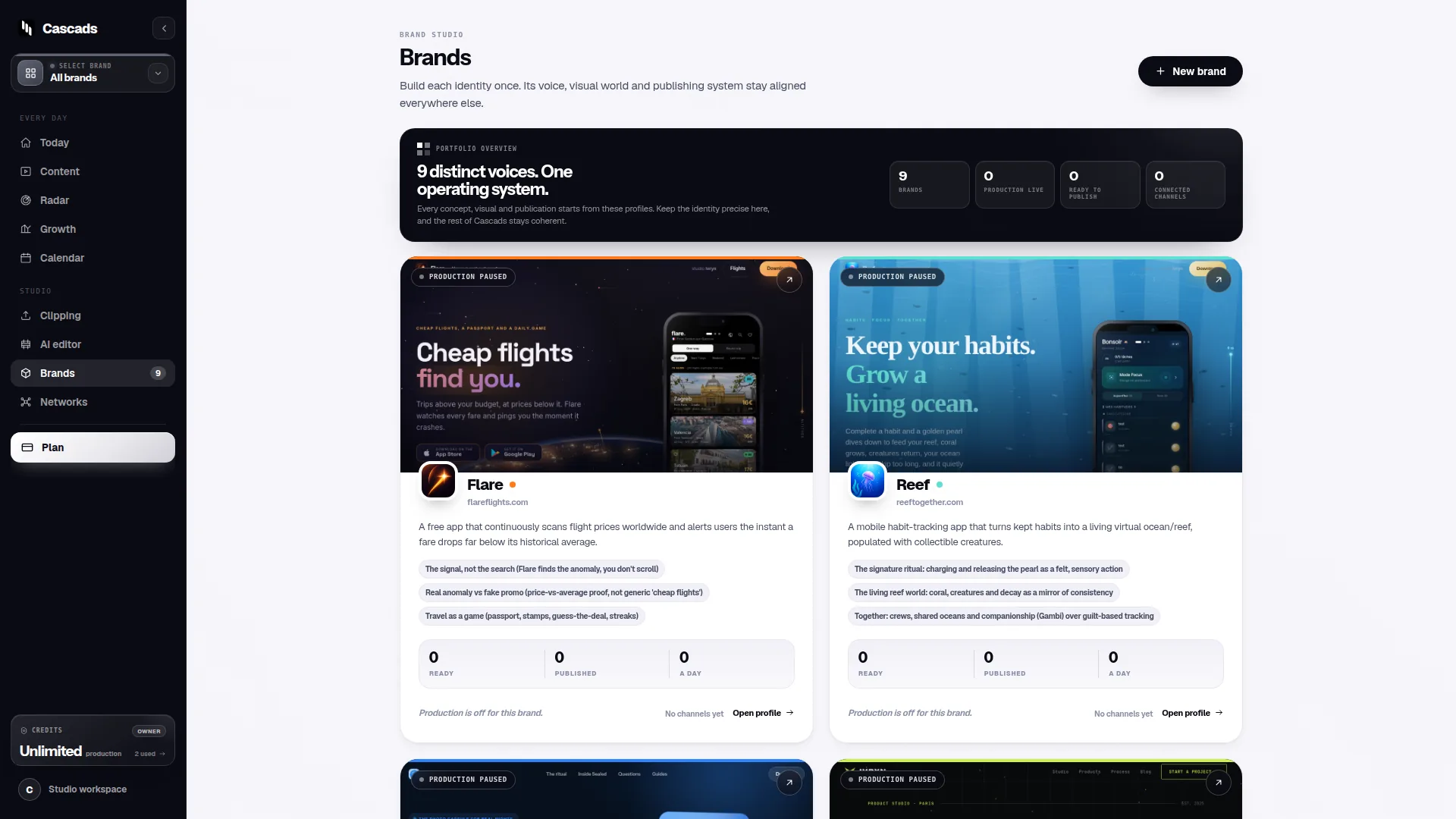
This is one of the areas where a dedicated product approach differs from stitching together open source components yourself. Cascads, for instance, is built around the idea of a reusable brand profile: instead of writing prompts or rules from scratch for every piece of content, a brand's context is stored once and applied across each new post, video, or carousel. That reduces the risk of drift when producing at volume across several brands, though the underlying need for someone to check the output before it goes live doesn't disappear.
If you're evaluating an open source project instead, ask specifically how it handles multi-brand context. Some projects assume a single account or a single voice; retrofitting brand separation into those tools can take as much engineering effort as building it from scratch.
Multi-format production and its practical limits
Social content today rarely means just text. Teams are expected to produce text posts, vertical video, and carousels, often from the same underlying idea, adapted to each network's format expectations. This is a meaningful automation target because manually reformatting one idea into three or four different asset types is genuinely repetitive work.
However, format-aware production is more complex than templating. A carousel that works on one network may need different pacing on another; a vertical video optimized for one platform's aspect ratio and caption placement may need adjustment before reuse elsewhere. Whether you use an open source toolchain or a managed product, check whether the tool actually understands these differences or simply resizes assets without adjusting for how each format is consumed.
Direct publishing of any of these formats also depends on factors outside the automation tool's control: the network's current API rules, the media format supported, the permissions granted to the connected account, and whether the platform approves the integration at all. This is true regardless of vendor, and it's worth confirming early rather than assuming a tool that generates content will also reliably publish it everywhere without friction.
Human review is not optional, no matter the tooling
Whatever automation you adopt, marketing output generated automatically should go through human review before it reaches an audience. This isn't a limitation specific to any one product; it reflects the reality that automated systems can misjudge tone, get facts wrong, or produce content that technically fits a format but doesn't fit the moment.
For agencies handling client work, this also has a contractual dimension: clients typically expect to see and approve content before it's published under their name, especially when several people can trigger scheduling. A workflow that skips this step to save time tends to create more cleanup work later than it saves upfront.
Cascads treats generated output, including scheduled posts and multi-brand campaigns, as material that stays subject to human review before publication rather than something that ships automatically once produced. That expectation is worth checking against any open source alternative you're evaluating, since some scripts default to auto-publish unless you deliberately add an approval gate.
- Confirm whether the tool has a built-in approval step or you must build one
- Decide who has final sign-off per brand, especially with multiple clients
- Log what was approved and when, in case of later disputes
A worked example: choosing between build-your-own and a managed tool
Example (hypothetical, not a case study): imagine a five-person agency handling six client brands, each wanting weekly text posts, occasional vertical video, and monthly carousels. A team member proposes stitching together an open source scheduler, a separate open source video-resizing script, and a spreadsheet for approvals.
Working through this hypothetical, the team would need to solve, on their own, how brand voice differs across six clients, how approval is tracked and enforced before anything posts, and how each output format is adapted per network rather than just resized. Each of these is solvable with enough engineering time, but the actual cost is that engineering time, not the software license.
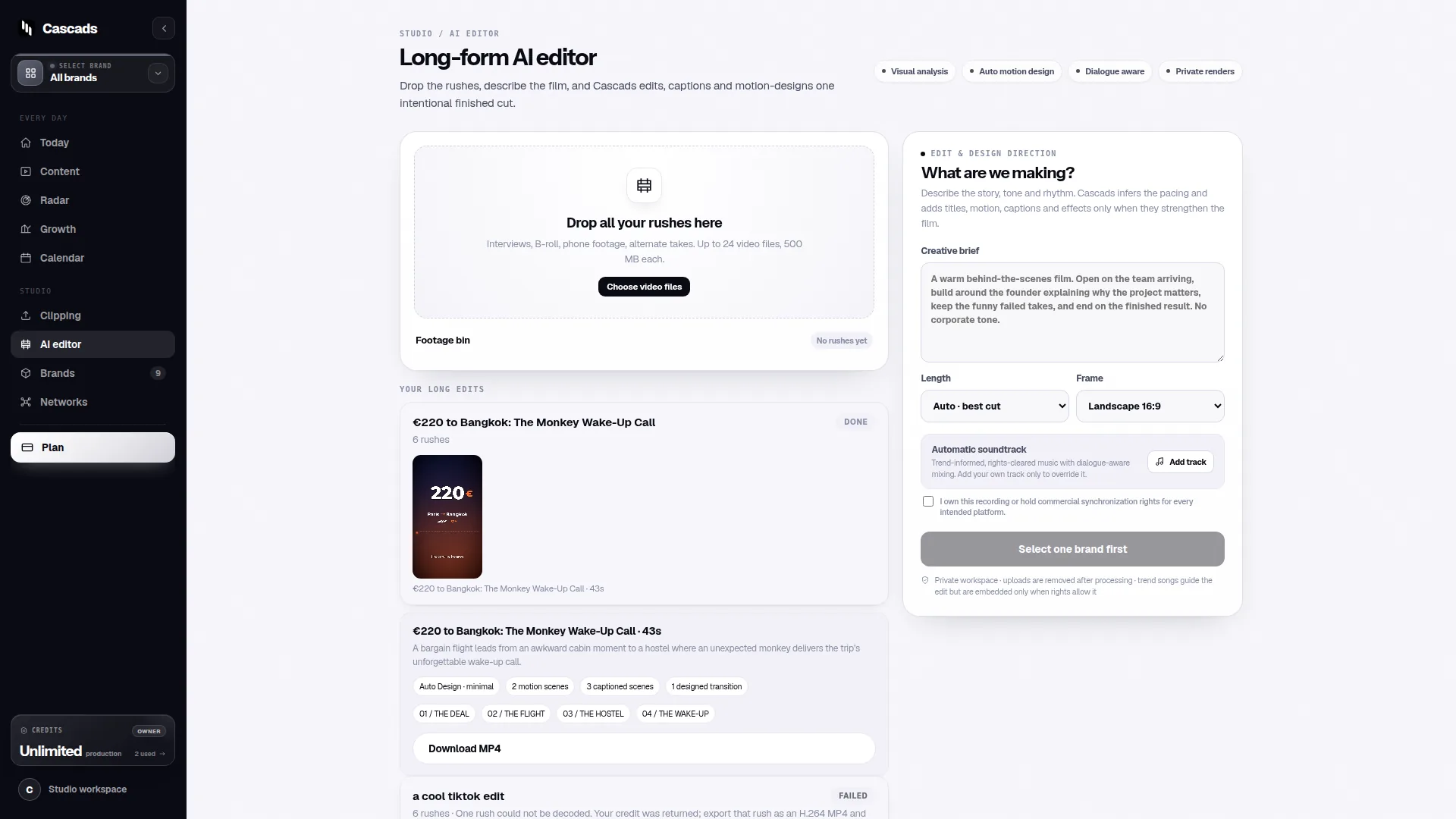
A managed product like Cascads exists to have already made these decisions: brand profiles, review-before-publish behavior, and multi-format generation are treated as core features rather than as things a team must assemble. The trade-off is less low-level control and typically a subscription cost instead of engineering time. Neither path is inherently correct; the right choice depends on whether the team has spare engineering capacity or spare budget, and how much customization they genuinely need versus how much they just assume they'll need.
A short decision checklist before committing to a tool
Rather than comparing feature lists, it's more useful to run through a short set of questions specific to your team's situation before adopting any social media automation open source project or managed alternative.
Use this checklist as a starting point, adapting it to how many brands, networks, and approvers your team actually has.
- Does the tool separate brand context per client, or assume one voice for everything?
- Does it generate the specific formats you need (text, vertical video, carousels) natively, or just resize existing assets?
- Is there a mandatory human review step before anything publishes, or do you have to build one?
- Have you confirmed, per network, which formats and permissions actually support direct publishing today?
- Who maintains the tool if it's open source, and what happens if that maintenance stops?
- What's the realistic engineering time cost of self-hosting versus a subscription cost of a managed product?
Where format-aware publishing checks come in
Even after choosing a tool, publishing itself needs its own checklist, since each network has its own rules about media format, account permissions, and app-level approval that can change independently of your content tool. This applies whether you're using an open source stack or a managed product like Cascads, and it's worth treating as a recurring check rather than a one-time setup step.
Resources like Cascads' publishing integration checklist and its approval workflow guide are useful references for thinking through this systematically: what to verify per network before assuming a post will go live automatically, and how to structure the review step so it doesn't become a bottleneck as volume grows across multiple brands.
Frequently asked questions
Is open source social media automation cheaper than a managed product like Cascads?
Open source tools typically remove licensing costs but shift the cost to engineering and maintenance time, especially for multi-brand context, format-specific generation, and building an approval step. Whether that's cheaper depends on whether your team already has spare engineering capacity; if not, the effective cost can end up comparable to or higher than a managed subscription.
Can automation tools publish directly to every social network without review?
Direct publishing always depends on the network's current API rules, supported media formats, the permissions granted to the connected account, and platform approval, so it isn't guaranteed across all networks. Regardless of those technical limits, generated marketing content should still go through human review before publication to catch errors automation can't reliably catch.
What should a small agency check first before adopting any social media automation tool?
Start by confirming whether the tool can keep separate brand context for each client rather than applying one voice to everyone, whether it natively produces the formats you need (text, vertical video, carousels), and whether it enforces a human approval step before anything publishes. These three checks matter more upfront than comparing feature lists or pricing.
Sources and further reading
These resources provide the wider reference frame. Product statements on this page are limited to the public information provided by Cascads.