Why the social media manager vs content creator question keeps coming up
Teams running social accounts for one or several brands often reach a point where a single person can no longer plan, produce and publish everything alone. The instinct is to hire, but the job title that gets posted is frequently a guess, blending two distinct functions into one. A social media manager and a content creator solve different problems, and confusing them tends to produce a hire who is either overloaded with strategy work while starved of production time, or highly productive on content but disconnected from scheduling, approvals and platform mechanics.
The comparison matters most for small teams and agencies juggling several brand accounts, because the cost of a mismatched hire compounds. If every brand needs its own voice, its own posting cadence and its own approval chain, the gap between 'someone who plans the calendar' and 'someone who makes the assets' becomes the difference between a smooth operation and a bottleneck.
What a social media manager actually does
A social media manager typically owns the account-level view: content calendars across networks, posting cadence, community response, and coordination with other teams (paid media, PR, product launches). Their output is less about individual assets and more about sequencing, consistency and the health of each channel over time.
In a multi-brand context, this role also carries the administrative weight of platform permissions, approval routing and knowing which formats a given network currently supports for direct publishing. That last part is not static - publishing capability for a given network, media format or account depends on platform rules and app permissions that can change, so the person in this seat needs to track constraints rather than assume they are fixed.
- Owns the calendar and cadence across networks and brands
- Coordinates approvals and permissions per account
- Tracks which formats and networks currently support direct publishing
- Responds to community activity and reports on channel health
What a content creator actually does
A content creator's core output is the asset itself: the video, the carousel, the caption, the visual treatment that fits a brand's voice. Their value is in production quality and creative range - turning a brief or a reusable brand profile into text posts, vertical video or carousels that feel consistent with what has come before.
Content creators are less likely to be the ones managing scheduling logistics or platform approval workflows, though in small teams they often end up doing some of both out of necessity. The risk of treating a content creator as a full replacement for a social media manager is that cross-brand consistency, approval discipline and publishing timing can slip when nobody owns them explicitly.
A social media manager vs content creator decision aid
Rather than treating this as an either-or hire, it helps to map your actual bottleneck. If your team already produces enough raw content but struggles to keep multiple brand calendars organized, get approvals through in time, or publish in the right format for each network, the gap is closer to social media manager work. If ideas and scheduling are fine but you consistently run out of finished assets, the gap is closer to content creator work.
Worked example: imagine a five-person agency managing four client brands. Each brand needs three posts a week across two networks. If the team's Trello board is full of approved briefs sitting untouched, the bottleneck is production - hire or contract a content creator, or lean harder on a tool that generates first-draft text posts, videos and carousels from each brand's profile so a smaller team can keep pace. If instead the board shows finished assets waiting because nobody has confirmed which account has permission to publish video on a given network, or approvals are stuck in someone's inbox, the bottleneck is coordination - that points to a social media manager, or to formalizing an approval workflow so drafts don't stall.
- Backlog full of unused approved briefs → production bottleneck, lean toward content creator
- Finished assets stuck waiting on approval or permissions → coordination bottleneck, lean toward social media manager
- Both bottlenecks present → consider whether tooling can absorb first-draft production so one coordinator can manage more brands
Where a tool like Cascads fits, and where it doesn't
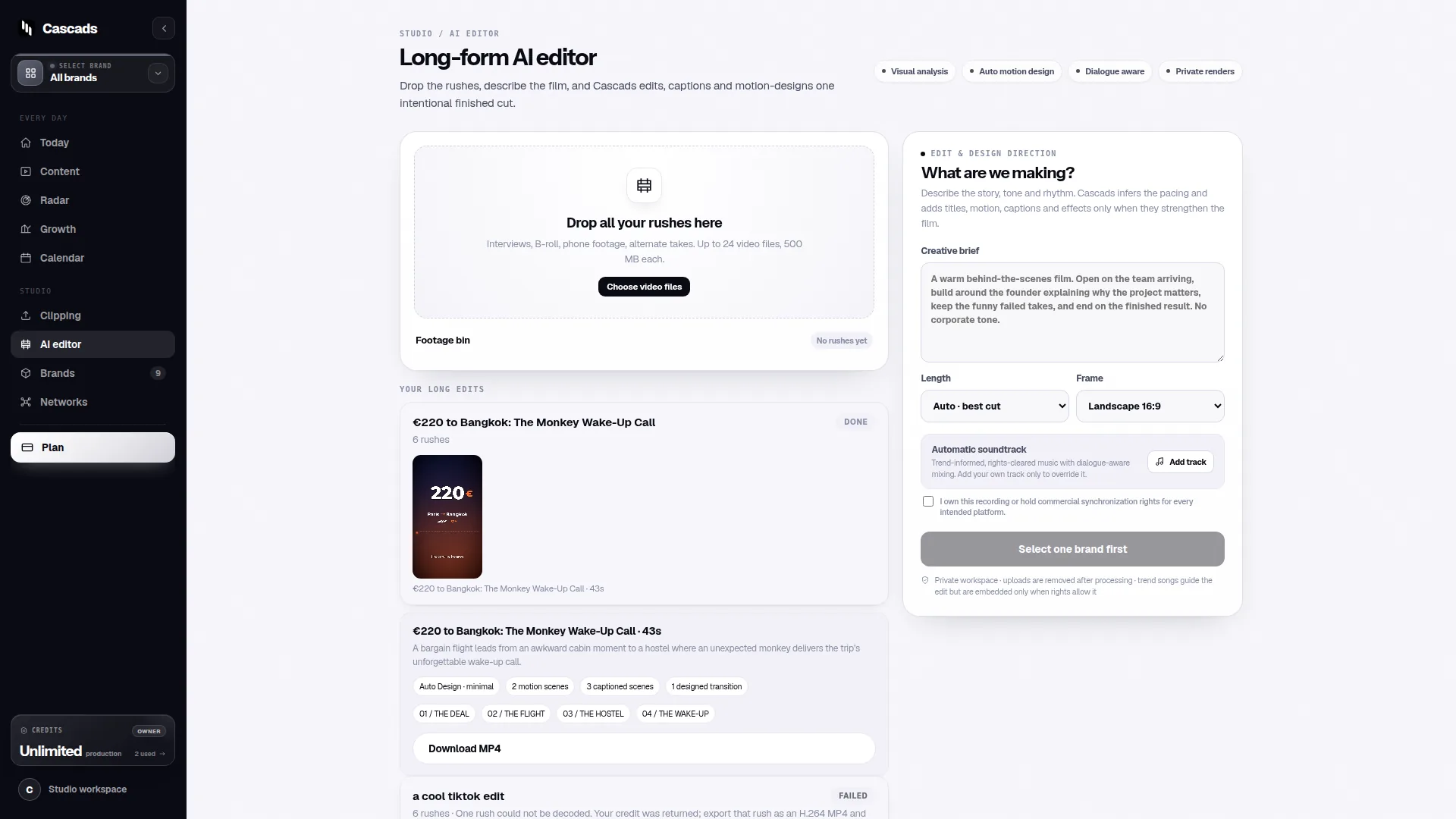
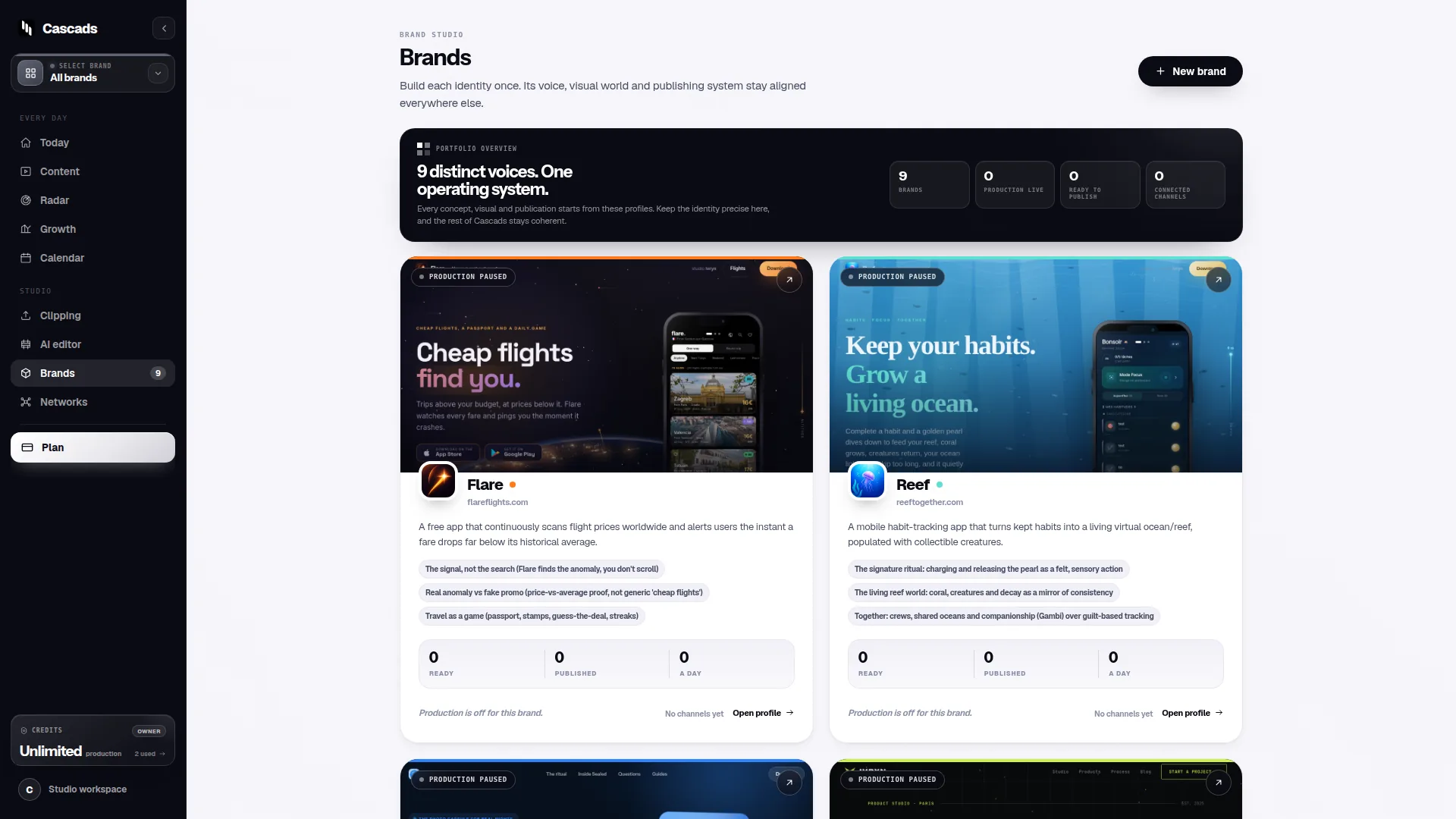
Cascads, from IVRYN, is built around a reusable profile per brand that it uses to generate text posts, vertical videos and carousels, which can reduce how much first-draft production work falls on a human content creator. It does not replace the judgment either role brings: generated output still needs human review before it goes live, and it does not decide your calendar strategy or manage community relationships for you.
It also does not remove the platform-side realities a social media manager has to track. Whether a piece of content can be published directly still depends on the network, the media format, the account's permissions and the external platform's own approval process, so a tool can shorten the drafting stage without eliminating the need for someone who understands each channel's current constraints and keeps drafts moving through review.
Building a workflow around whichever hire you make
Whichever role you prioritize, the workflow around them matters as much as the title. A clear approval step before anything reaches a live account protects brand consistency across every hire, whether the draft came from a content creator, a social media manager, or a generation tool. Skipping that review step to save time tends to create more rework later, particularly across multiple brands where voice and compliance expectations differ.
It's also worth documenting, per brand and per network, what direct publishing actually requires - which accounts have the right permissions, which formats each platform currently accepts, and where a human still has to click publish manually. Treating that as a living checklist rather than a one-time setup step avoids surprises when a platform changes its rules or a new account is added.
Frequently asked questions
Is a social media manager more senior than a content creator?
Not inherently - they are different functions rather than different levels of seniority. A social media manager focuses on calendar, coordination and channel health, while a content creator focuses on producing the assets themselves; a small team may need both, and either can be senior or junior depending on scope.
Can one person do both jobs for a small team?
Yes, and many small teams start this way, but it works best when the team is honest about which function is being neglected as volume grows - usually production capacity or coordination discipline, whichever slips first once a single person can't keep up with both.
Does using an AI content tool remove the need for a content creator or social media manager?
No. A tool that generates first-draft posts, videos or carousels can reduce production time, but generated content still needs human review before publishing, and someone still needs to manage calendars, approvals and platform-specific publishing constraints.
Sources and further reading
These resources provide the wider reference frame. Product statements on this page are limited to the public information provided by Cascads.