What social media management with ai actually changes
For a small team or agency running several brands across several networks, the daily bottleneck is rarely ideas. It's turning a brand's voice into a steady stream of on-format posts without a person starting from a blank page every time. Social media management with ai, at least in the way it's applied in tools built for this workflow, mainly changes the drafting step: it produces a first version of a post, a script for a vertical video, or the panels of a carousel, based on a description of the brand rather than a fresh brief each time.
That distinction matters because it sets expectations correctly. AI assistance here is a production accelerant, not a replacement for judgment about what a brand should say, to whom, or when. Anyone evaluating a tool in this category should ask whether it's speeding up the parts of the job that are repetitive and format-specific, or promising to replace editorial decisions entirely - the latter is a claim worth being skeptical of.
Brand context as the starting point
A recurring problem with generic content generation is that it forgets who it's writing for between one post and the next. A workable approach to social media management with ai keeps a reusable profile for each brand - tone, positioning, recurring themes, visual constraints - so that drafts stay recognizably on-brand without a person re-explaining the basics every session.
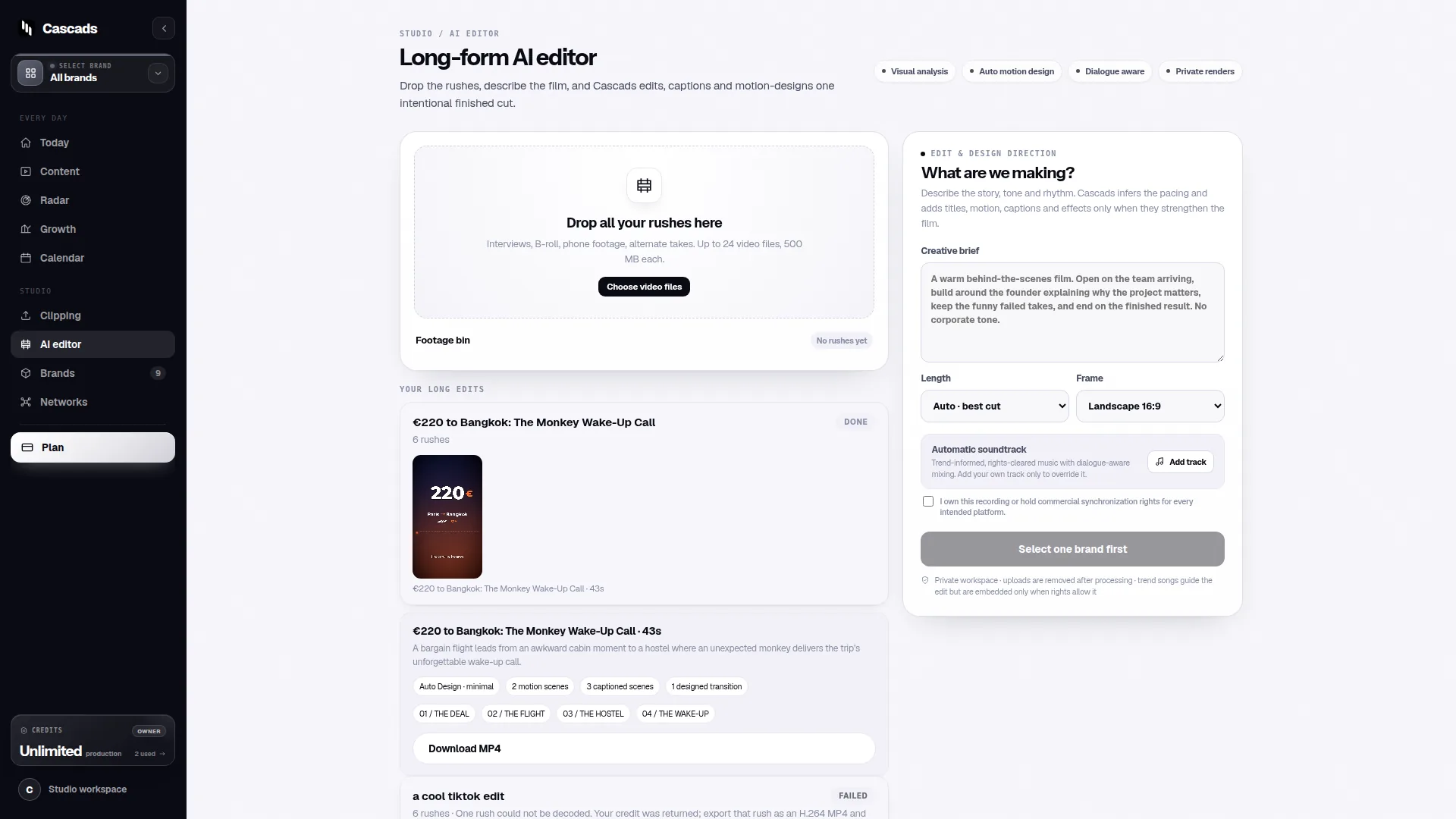
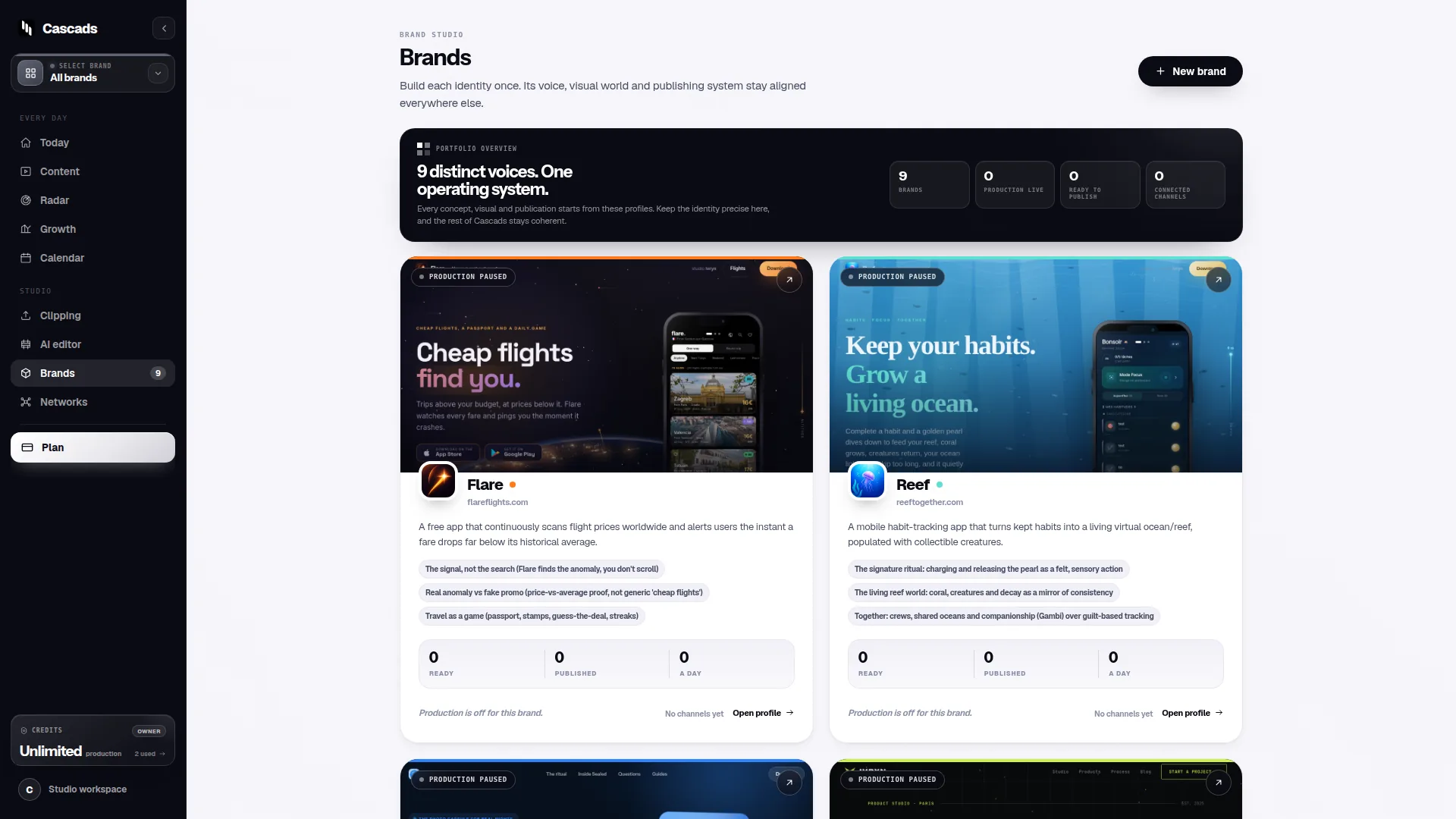
Cascads, an IVRYN product, works this way: it builds and reuses a brand profile to generate text posts, vertical videos and carousels, rather than treating each request as an isolated prompt. For a team managing multiple brands, this is less about a specific feature and more about reducing the setup cost of staying consistent across accounts.
The practical implication for anyone comparing tools is to check how brand context is stored and updated. If updating a brand's positioning requires re-teaching the tool from scratch each time, the time saved on drafting gets eaten up elsewhere.
Multi-format production and its limits
A single campaign idea rarely fits one format. A short article idea might need a text post, a script for a 30-second vertical video, and a carousel breaking down the same point into slides. Producing all three from one source of brand and topic input, rather than redoing the thinking three times, is where multi-format generation earns its place in a workflow.
That said, formats aren't interchangeable outputs from the same template. A carousel needs pacing across slides; a vertical video needs a spoken or on-screen script that works with sound or captions; a text post needs to stand alone. Any tool producing multiple formats should be judged on whether each format is genuinely fit for its medium, not just resized or reworded from the others.
This is also where a reader should temper expectations: generating a draft in three formats is a starting point for editing, not a finished, ready-to-post set of assets.
Why human review stays in the loop
Nothing about generating content faster removes the need for someone to read it before it goes out. Brand voice drift, factual errors, tone mismatches for a specific platform's audience, or simply a draft that doesn't fit the moment - these are the kinds of issues a human editor catches and a generation step doesn't reliably catch on its own.
In practice this means treating AI-produced drafts the same way a team would treat drafts from a junior writer: useful, often close to final, but not published unreviewed. Cascads' own approach keeps generated marketing output subject to human review before publication, which reflects a broader point about this category of tool: speed in drafting should not be confused with authority to publish.
Format-aware publishing and platform limits
The step after drafting - actually getting content live on a network - is where many teams underestimate the complexity. Direct publishing from any tool depends on the specific network, the media format involved, the permissions granted on the connected account, and approval from the platform itself. None of these are guaranteed or fully within a tool vendor's control, since platforms set and change their own rules for third-party publishing access.
A social media publishing integration checklist is useful here precisely because it turns a vague expectation ('the tool posts for me') into a concrete list of dependencies to verify: which networks support direct publishing for which formats, what account-level permissions are required, and where a manual export-and-post step is still the reality. Teams that skip this check often discover the gaps only when a specific format or account fails to publish as expected.
Similarly, an approval workflow - where drafts move through review before anyone hits publish - is worth setting up deliberately rather than assuming a tool enforces it by default. Format-aware publishing and a clear approval step are two separate mechanics that both need to be in place for a multi-brand, multi-network operation to run smoothly.
- Confirm which networks and formats support direct publishing before relying on it
- Check what account permissions the connected profile actually has
- Build an explicit human review step into the workflow, not an assumed one
- Treat platform approval as external and out of the tool's control
A worked example: rolling out one campaign across three brands
Consider a hypothetical agency managing three unrelated brands, each with its own tone and audience, that wants to run a seasonal campaign across text posts, a vertical video and a carousel on each brand's accounts. This is an illustrative scenario, not a documented case.
Given brand profiles are already set up, the drafting step could generate a first pass of all three formats per brand - nine assets in total - using the campaign brief as shared input and each brand's profile for tone and positioning. From there, an editor reviews each asset against the brand's actual voice and current context, adjusting anything that reads generically or misses a nuance specific to that brand.
Before scheduling, the team checks the publishing integration for each network: does this account support scheduled video posts, does the carousel format have an approved connection, are permissions current. Only after that check and human sign-off does anything move into the publishing queue. The value in this scenario isn't that AI removed steps - it's that the drafting and formatting groundwork no longer has to be redone by hand for every brand and format combination.
Setting realistic expectations with your team
Teams adopting social media management with ai tend to get the most benefit when they're explicit about what the tool is responsible for versus what stays a human decision. Drafting speed and format coverage are reasonable things to expect improvement on. Final voice accuracy, timing judgment, and publishing reliability across every platform are not things any generation tool can fully guarantee, because they depend on review quality and on external platform behavior.
Setting that boundary early - in writing, as part of a team's workflow documentation - avoids the more common failure mode: a team assumes a tool handles publishing end-to-end, skips the review and integration checks, and finds out about a permissions or format gap only when a post fails to go out.
Frequently asked questions
Does AI-generated social content still need human review before publishing?
Yes. Generated drafts - whether text posts, video scripts or carousels - should go through human review for accuracy, tone and fit before publication, since generation tools do not reliably catch every brand or factual issue on their own.
Can AI tools publish directly to every social network?
Not reliably. Direct publishing depends on the specific network, the media format, the permissions granted on the connected account, and approval from the platform itself, so this should be checked per network and format rather than assumed.
What does having a reusable brand profile actually help with?
A reusable brand profile stores a brand's tone, positioning and recurring themes so that generated drafts stay consistent across posts and formats without re-explaining the brand context every time, which is especially useful for teams managing several brands at once.
Sources and further reading
These resources provide the wider reference frame. Product statements on this page are limited to the public information provided by Cascads.