What social media management freelance work actually involves
A social media management freelance practice usually means juggling several client accounts, each with its own tone, audience and posting cadence, while trying to keep output consistent enough that clients don't have to micromanage every caption. The work is rarely just 'writing posts' - it includes planning a rhythm across formats, adapting a message per network, and staying inside whatever approval process a client expects before anything goes live.
The practical difficulty is less about creativity and more about repetition without drift. A freelancer managing five brands needs each client's content to sound like that client, not like a generic template reused five times. That's the specific problem that brand-context tooling, including Cascads, is built to reduce: a reusable profile per brand that anchors tone and format choices so each generation starts from the right baseline instead of a blank page.
Brand context is what keeps multi-client work from blurring together
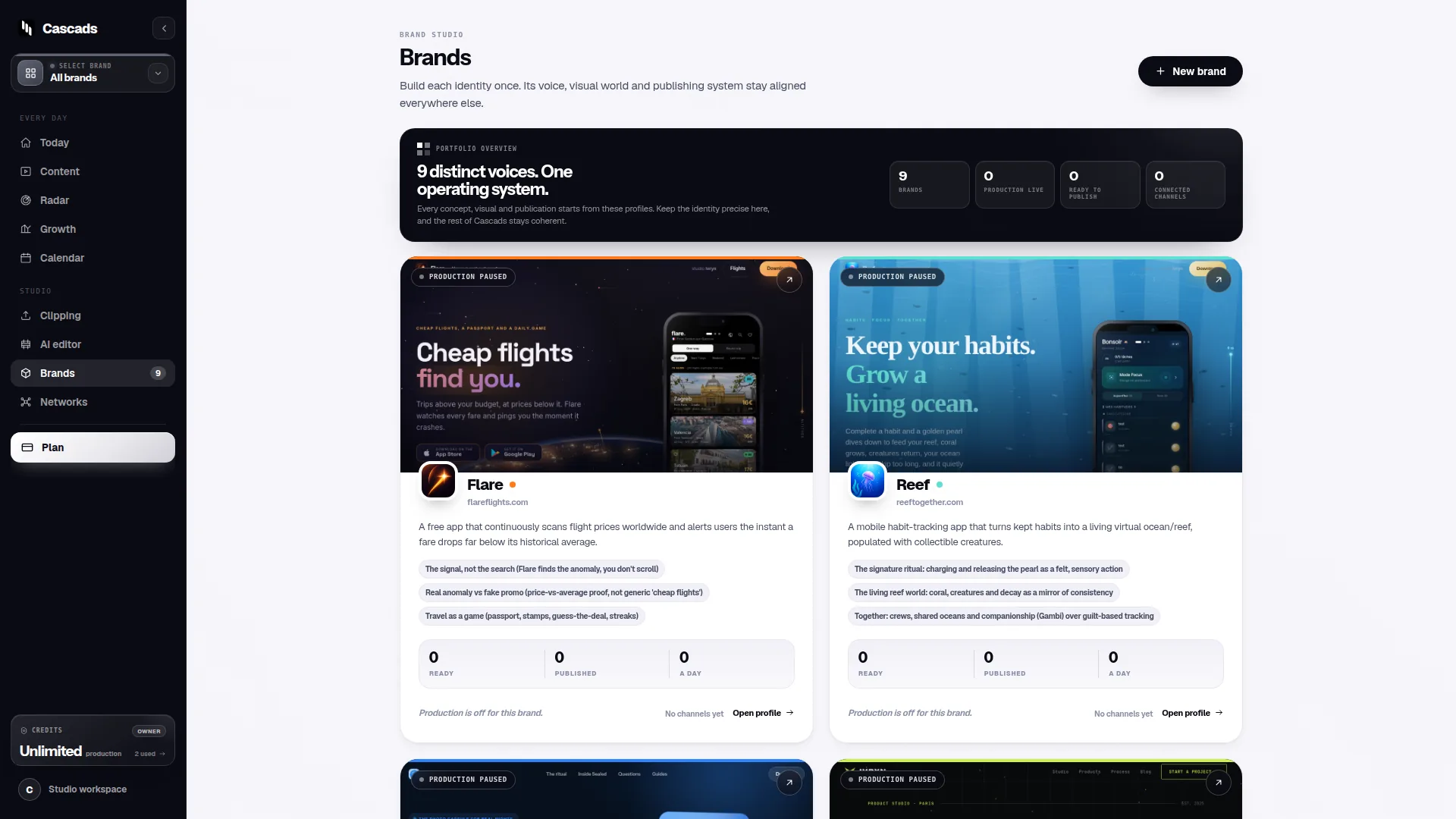
When someone manages content for multiple brands, the biggest operational risk is not lack of ideas but inconsistency: a post that reads right for one client but wrong for another because the underlying voice, audience or product facts weren't re-established. A reusable profile per brand - the way Cascads structures it - is meant to hold those constants (audience, tone, recurring topics) so that new content generation for a given brand stays anchored, even when the freelancer is context-switching all day between accounts.
This matters more as client count grows. Two or three accounts are manageable from memory. Beyond that, freelancers typically need some structural aid - a profile, a style sheet, a set of saved references - or quality becomes uneven precisely at the moments when they're busiest. Evaluating any tool for this kind of freelance work should include asking how it stores and reuses brand context, not just how fast it drafts a single post.
Multi-format production and why it doesn't replace judgment
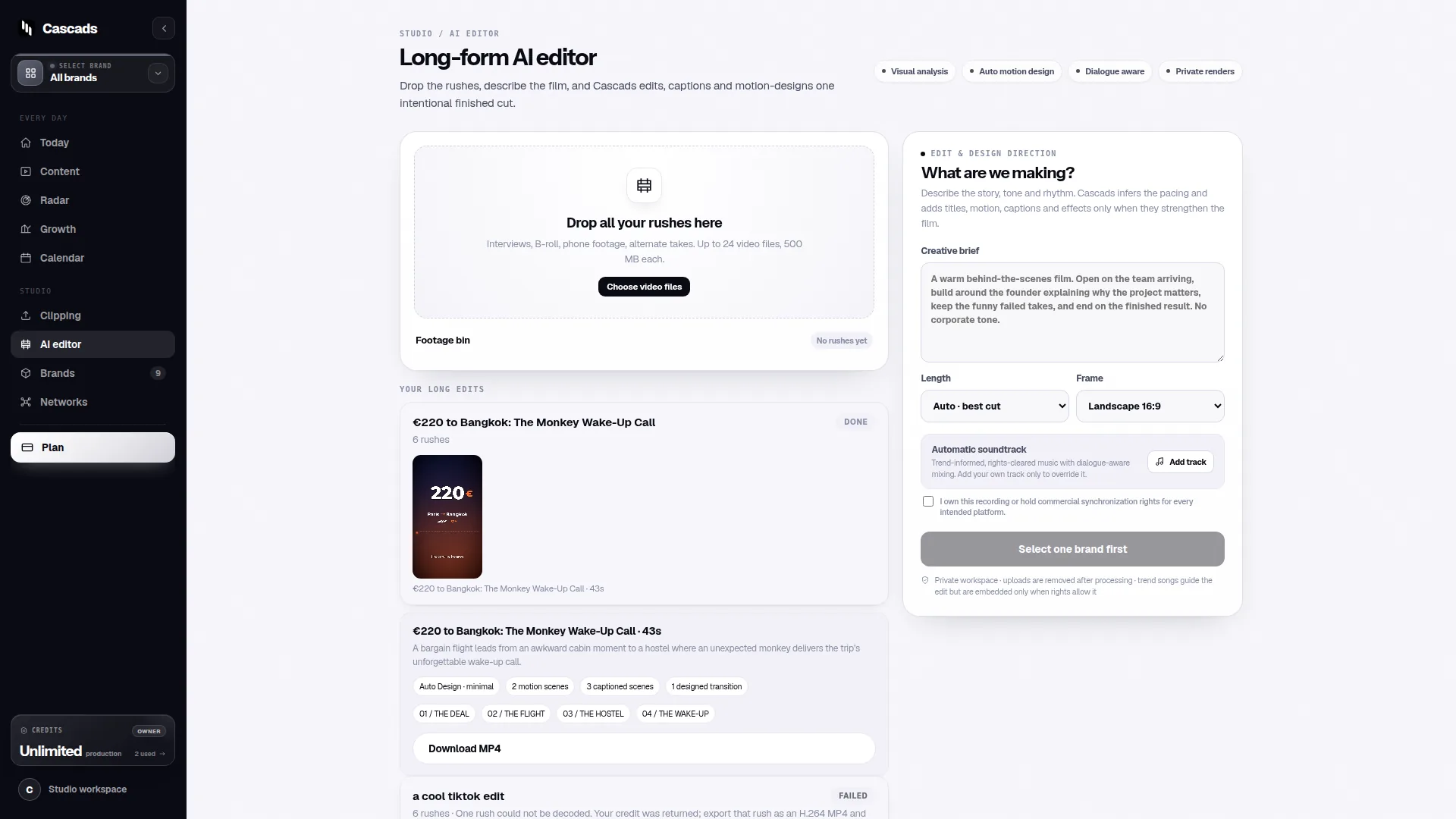
Social media management freelance work spans several content shapes: static text posts, vertical video, carousels, and increasingly a mix depending on the network's current preferences. Producing all of these from a single starting brief - rather than starting over per format - is a real efficiency gain, and it's part of what Cascads generates from a brand profile: text posts, vertical videos and carousels derived from the same reusable input.
That efficiency doesn't remove the need for judgment about which format suits which message. A promotional announcement might work as a carousel for one client and feel wrong as a video for another, depending on their audience and past performance patterns the freelancer already knows. Multi-format generation speeds up the first draft; it doesn't decide strategy, and freelancers should treat it as a production accelerator rather than a planning replacement.
Human review is not optional, even under freelance time pressure
Generated marketing output, whatever tool produces it, remains subject to human review before publication - this is true structurally, not just as a best practice. For a freelancer working across multiple clients, that review step is also where legal, tonal and factual mismatches get caught before they become client-facing problems. Skipping it to save time on a busy day is exactly when errors slip into a live account.
A workable review habit for freelance work is short but consistent: check that facts about the brand are current, that the tone matches what that specific client expects, and that nothing implies a claim the client hasn't approved (pricing, availability, guarantees). Building this into a fixed step of the workflow, rather than an occasional check, is what keeps volume from becoming a liability.
Format-aware publishing and platform limits freelancers must plan around
Direct publishing from any management tool, Cascads included, depends on the network, the specific media format, the connected account's permissions, and approval from the external platform itself. None of these are fully within a tool's control, which means a freelancer's publishing plan should assume some manual steps will remain - especially for newer formats or accounts with restricted permissions.
This is where an integration checklist becomes genuinely useful groundwork rather than a formality. Before committing a client's workflow to automated or semi-automated publishing, it's worth confirming which formats that client's connected accounts can actually post directly, versus which will require manual upload or extra approval. Cascads' own guide on this - the social media publishing integration checklist - is one useful reference point for the kinds of questions to ask (account permissions, format support, platform-side review) regardless of which tool a freelancer ultimately uses.
A worked example: onboarding three clients without losing consistency
Consider a hypothetical freelancer, call her Dana, taking on three new clients in the same month - a bakery, a fitness coach, and a small software company. Each has a different tone (warm and local, energetic and personal, plain and informative) and different platform mixes (Instagram-heavy, TikTok-and-Instagram, LinkedIn-and-X). The risk in onboarding all three at once is that under time pressure, content starts to sound interchangeable.
In this hypothetical, Dana would set up a separate profile per client capturing their audience, tone and recurring topics before generating anything, then use multi-format generation to get a first draft across the formats each client actually needs - carousels for the bakery, vertical video for the fitness coach, text posts for the software company. She'd still review every draft against that client's voice and check, per the integration checklist logic, which formats each client's connected accounts can post directly versus what needs manual handling. Cost also enters the decision at this stage: with three clients on one subscription, Dana would want to understand how the tool's pricing scales with account or brand count rather than assuming a flat rate - the kind of variable Cascads' guide on social media management software cost is meant to help evaluate.
This is illustrative only, not a report of a real engagement or measured outcome - it's meant to show how the principles (brand context, multi-format production, human review, format-aware publishing) fit together in a realistic freelance scenario, not to claim a tested result.
A short decision checklist before adopting a tool for freelance social work
Before committing client work to any social media management tool, freelancers benefit from running through a small set of concrete questions rather than judging on demo appeal alone.
- Does the tool store a distinct, reusable profile per brand, or does everything reset per session?
- Can it generate the specific formats your clients actually need (text, vertical video, carousels), or only some of them?
- Is there a clear review step before anything can publish, and can you enforce it for junior team members?
- Does direct publishing actually work for each client's connected accounts and formats, or will some posts need manual upload?
- How does pricing change as you add more brands or client accounts - flat, per-brand, or tiered?
Frequently asked questions
Is a freelance social media manager responsible for approving content before it posts?
Yes - generated marketing content should always go through human review before publication, and a freelancer managing client accounts is typically the one responsible for that check, since platforms and clients hold the freelancer accountable for what actually goes live.
Can social media management software publish directly to every platform and format?
Not universally. Direct publishing depends on the specific network, the media format involved, the connected account's permissions, and approval from the external platform, so some formats or accounts may require manual posting regardless of which tool is used.
How should a freelancer compare pricing across social media management tools for multiple clients?
Look at how cost scales with the number of brands or connected accounts rather than a single advertised rate, since per-client structures vary and a tool that's affordable for one client's account may cost significantly more once several client brands are added.
Sources and further reading
These resources provide the wider reference frame. Product statements on this page are limited to the public information provided by Cascads.