What people usually mean by a social media calendar tool free
When someone searches for a social media calendar tool free, they are usually trying to solve two separate problems at once: planning what to post and when, and actually getting posts out to each network without manual copy-pasting. Free tiers of scheduling tools tend to cover the planning side reasonably well - a shared grid, some tagging, maybe a content queue - but the publishing side is where free plans diverge sharply from paid ones.
This matters because a calendar that only shows dates without reliable publishing behind it just becomes another spreadsheet with nicer colors. Before evaluating any tool, it helps to separate the calendar view (what you see) from the publishing mechanism (what actually happens on each network) since free tools often bundle the two loosely.
Brand context: why a single generic calendar breaks down for teams
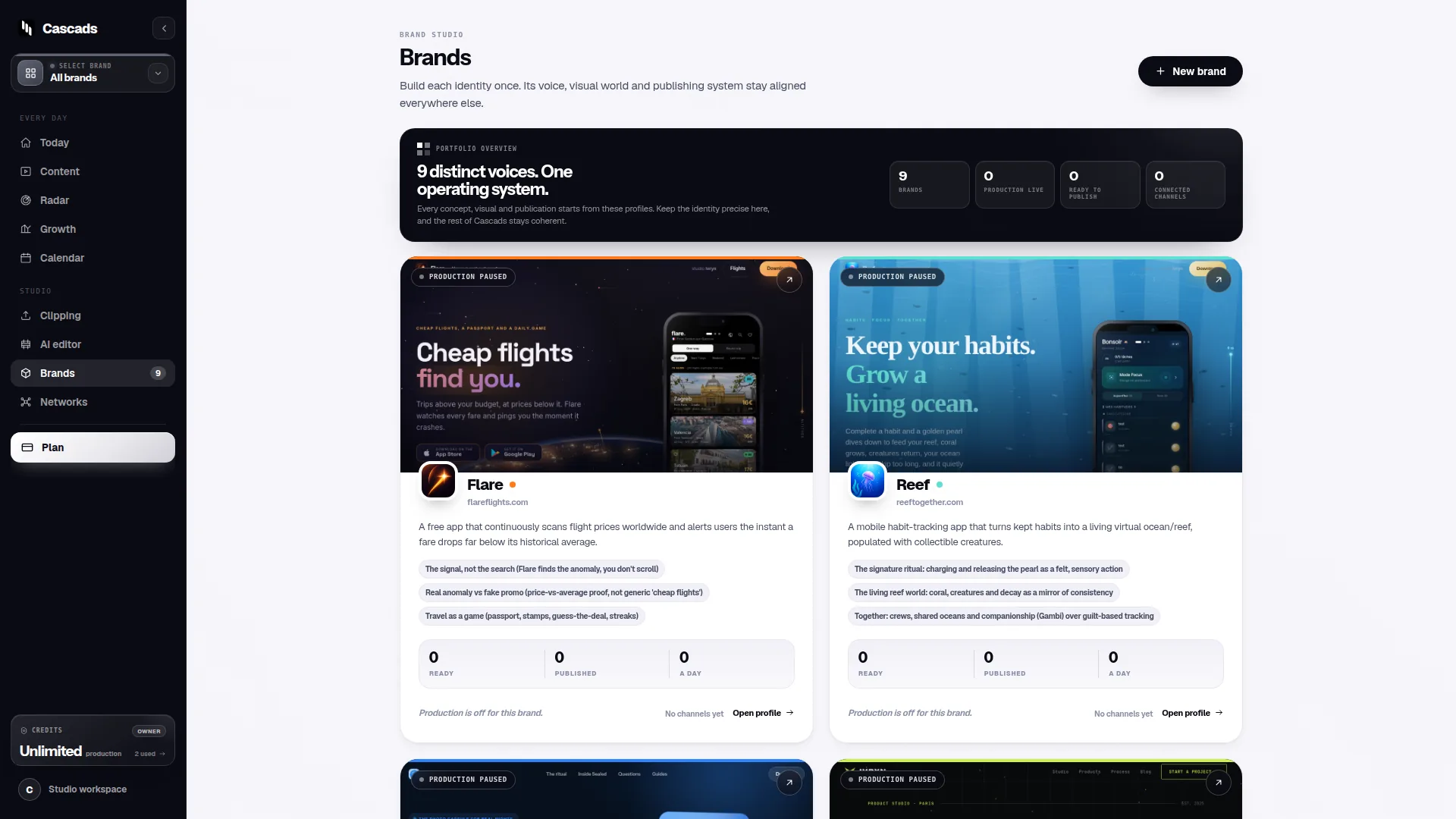
Small teams and agencies rarely manage one voice. A social media calendar tool free of brand-specific structure will let you drop posts into dates, but it won't remember that Brand A never uses emoji, Brand B posts in two languages, or Brand C has a different approval chain than Brand D. Without a reusable profile per brand, someone ends up re-explaining tone, hashtags and visual style every single time content is created, which is exactly the friction a calendar tool is supposed to remove.
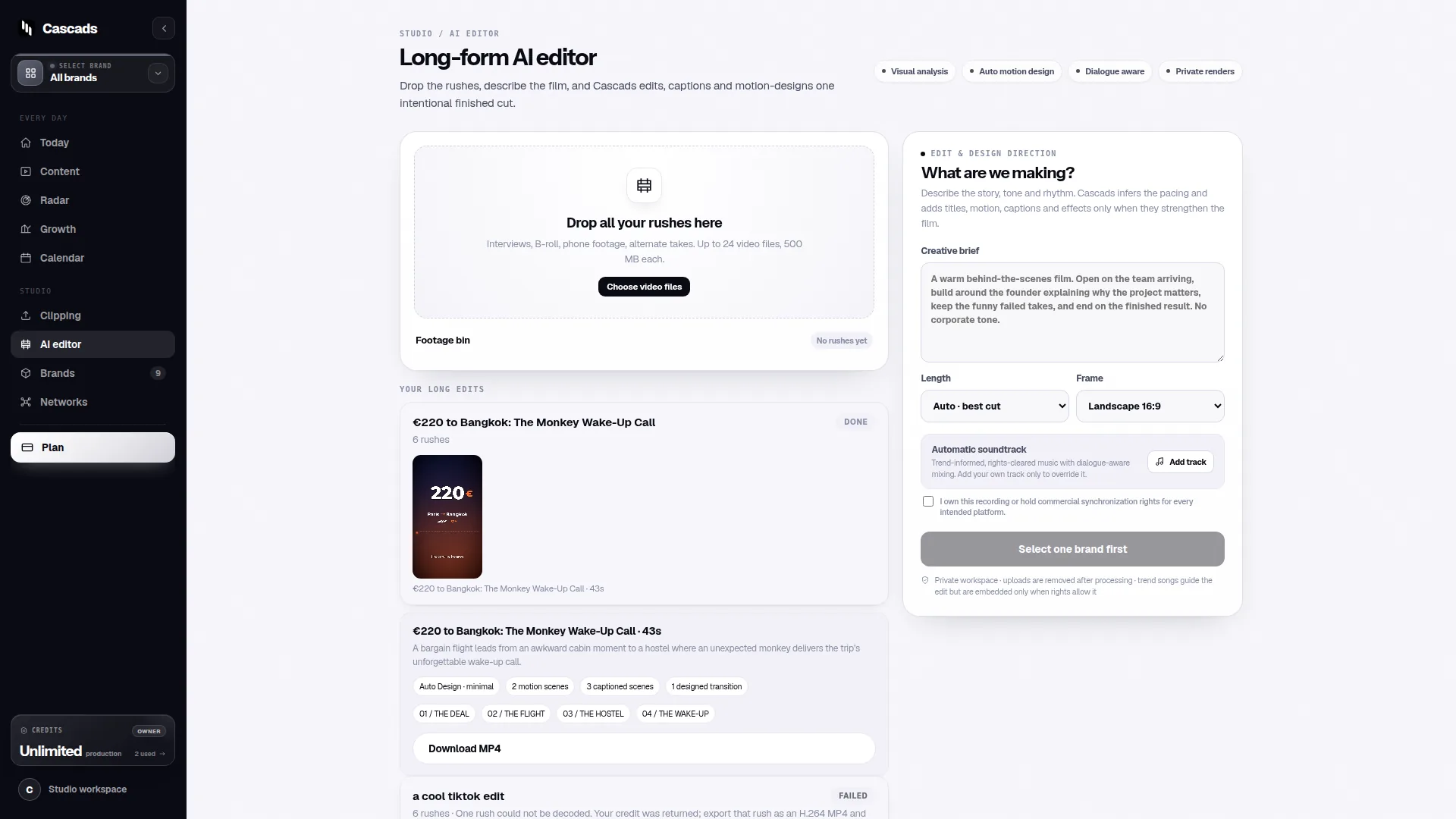
Cascads is an IVRYN product built around this specific gap: it generates text posts, vertical videos and carousels from a reusable profile for each brand, so the brand context doesn't have to be re-entered for every batch of content. That's a narrower claim than 'manages your whole calendar' - it's specifically about keeping brand identity consistent as production scales across accounts.
If you're comparing tools, a useful question is not 'does it have a calendar view' (most do) but 'does it remember who each brand is between sessions, or does every post start from a blank slate.'
Multi-format production and why it changes what 'free' can cover
A text post, a vertical video and a carousel have different production costs, different review needs and different platform quirks. A free calendar tool that only handles single-image or text scheduling will not necessarily extend cleanly to video or carousel formats, because those formats often require additional processing, longer upload windows, or platform-specific packaging that free tiers commonly gate behind paid plans.
This is worth checking explicitly before committing time to a workflow: does the tool generate and schedule the format mix you actually use, or just the easiest one to demo. According to Cascads' guide on multi-brand social media content calendars, structuring a calendar around brand and format together - rather than dates alone - is what keeps multi-format production organized as the number of brands grows.
For teams producing across several brands and networks, the practical test is whether the tool's free tier lets you plan a week that mixes formats for more than one brand without hitting a wall halfway through.
Human review stays part of the workflow regardless of the tool
No calendar tool, free or paid, removes the need for a human to look at content before it goes live. Generated marketing output - whether written by a person or produced with help from an AI-assisted tool - remains subject to human review before publication. This isn't a limitation specific to any one product; it's a baseline expectation for any team managing brand reputation across multiple accounts.
Practically, this means the calendar tool's value isn't just 'automates posting' but 'makes review easy to insert into the workflow.' A tool where review is a separate, disconnected step invites more errors than one where drafts, approvals and scheduled slots live in the same view.
When evaluating a free plan, check whether it supports any kind of draft/approval state distinct from 'scheduled.' If everything goes straight from creation to the queue, that's a workflow gap worth planning around rather than ignoring.
Format-aware publishing: the part most free tools gloss over
Direct publishing depends on the network, media format, account permissions and external platform approval. This is true across the industry, not specific to any one vendor, and it's the single biggest source of frustration with free calendar tools: a post that looks perfectly scheduled in the calendar view can still fail to go live because a platform's API doesn't support that format for that account type, or because permissions weren't fully granted.
Cascads' publishing integration checklist frames this as something to verify per network and per format before relying on a tool for direct posting - confirming account permissions, checking which formats are actually supported for direct publish versus manual export, and understanding what happens when a platform rejects a scheduled post.
A reasonable expectation to set going in: even a well-built free tool may only support automatic direct publishing for a subset of networks and formats, with the rest requiring manual posting or export. Treat that as normal rather than a defect, and design the calendar around it.
Worked example: choosing a free tool for a three-brand agency
Example, not a real case: an agency manages three client brands, each posting text updates twice a week and one vertical video weekly, across two networks per brand. Before picking a free social media calendar tool, they'd want to check a few things concretely.
This kind of worked-through checklist is more useful than a feature list, because it forces the comparison down to the agency's actual weekly volume and format mix rather than an abstract list of supported networks.
- Can each brand have its own saved profile (tone, visuals, hashtags) or does content start from scratch each time?
- Does the free tier support vertical video, or only static images and text?
- For each of the two networks per brand, is direct publish actually supported, or does it fall back to manual posting for some formats?
- Is there a draft/review state before a post goes live, so an approver can catch a wrong brand voice before it's scheduled?
- What happens to scheduled posts if platform approval is delayed or rejected - does the tool flag this or fail silently?
Setting realistic expectations before adopting a tool
A social media calendar tool free of cost is not free of constraints. The realistic framing is: use it to organize planning and reduce repetitive brand setup, expect publishing reliability to vary by network and format, and keep human review in the loop regardless of how automated the scheduling looks.
None of this is a reason to avoid free tools - it's a reason to evaluate them against your actual brand count, format mix and network list rather than a generic feature checklist. Tools like Cascads are built around specific parts of this problem (brand profiles, multi-format generation) rather than promising to solve publishing reliability universally, and that scoping is worth checking against whatever tool you're considering.
Frequently asked questions
Is a free social media calendar tool enough for managing multiple brands?
It depends on whether the tool supports separate profiles or settings per brand. A calendar that only offers a shared queue without brand-specific context (tone, visuals, formats) will require manual re-entry of brand details each time, which adds friction as the number of brands grows.
Why does a scheduled post sometimes fail to publish automatically?
Direct publishing depends on the network, the media format, the account's granted permissions, and the platform's own approval process. Any of these can block automatic publishing even when a post appears correctly scheduled in the calendar, which is why manual fallback options matter.
Do AI-assisted or automated content tools remove the need for manual review?
No. Generated marketing output, including text posts, videos and carousels produced with automation, remains subject to human review before publication. Automation can speed up production and scheduling, but it does not replace a review step for brand accuracy and compliance.
Sources and further reading
These resources provide the wider reference frame. Product statements on this page are limited to the public information provided by Cascads.