What people actually mean by social media automation free
Anyone searching social media automation free is usually trying to solve a practical problem: too many brands, networks and formats to manage by hand, and a limited budget to fix it. The phrase covers a wide range of things in practice, from a free tier of a paid platform, to a free trial period, to genuinely free scheduling tools with narrow feature sets. Before evaluating any option, it helps to be precise about which of these you are actually looking at, because the tradeoffs differ substantially.
A free tier typically caps the number of connected accounts, scheduled posts, or brands you can manage at once. A free trial gives full access for a limited window, after which you either pay or lose functionality. Fully free tools tend to be free because they are simpler, ad-supported, or built around a narrower use case such as single-network scheduling. None of these are inherently bad choices, but conflating them leads to picking a tool that quietly stops working once you scale past its limits.
Where automation genuinely helps a multi-brand workflow
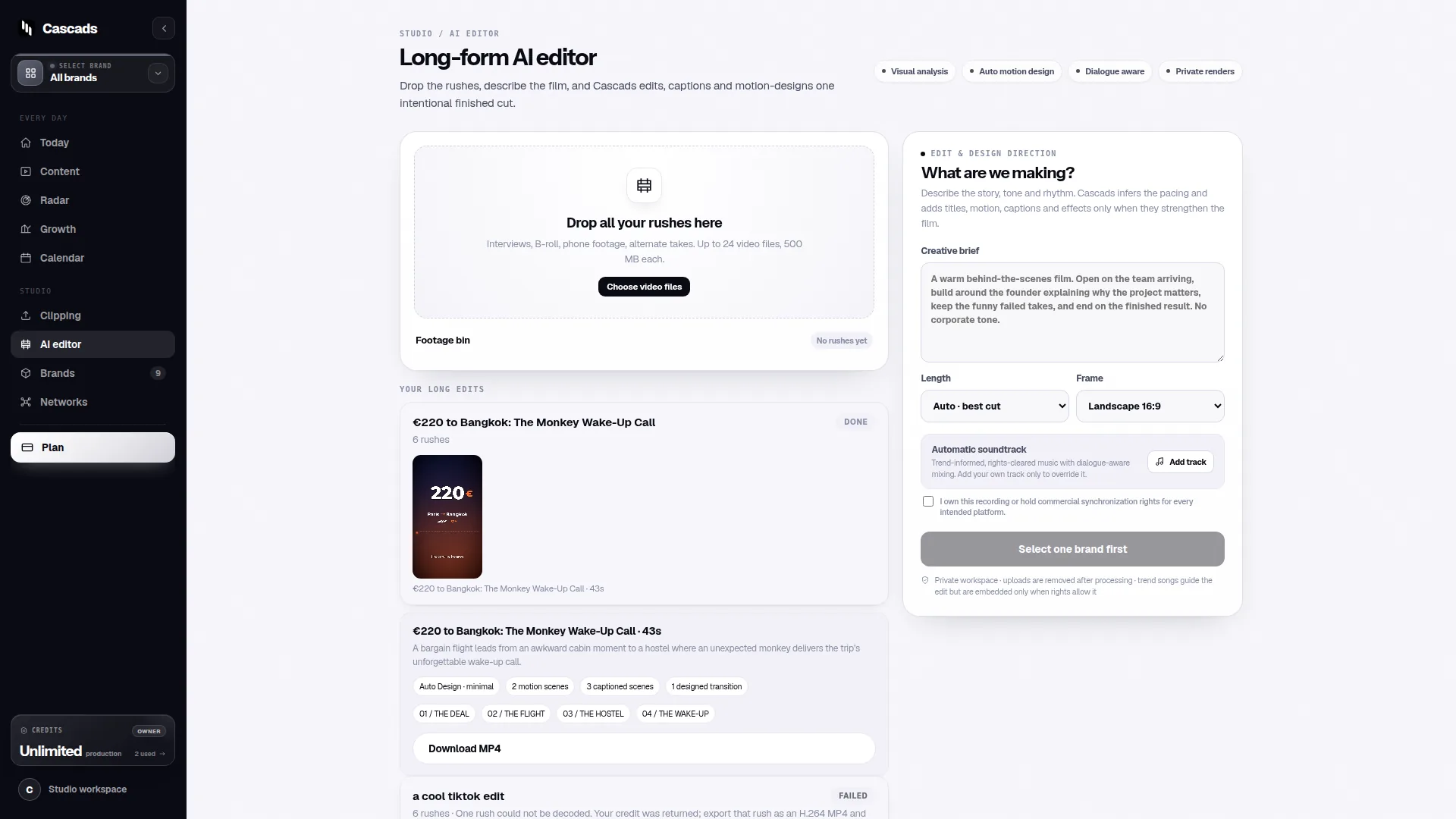
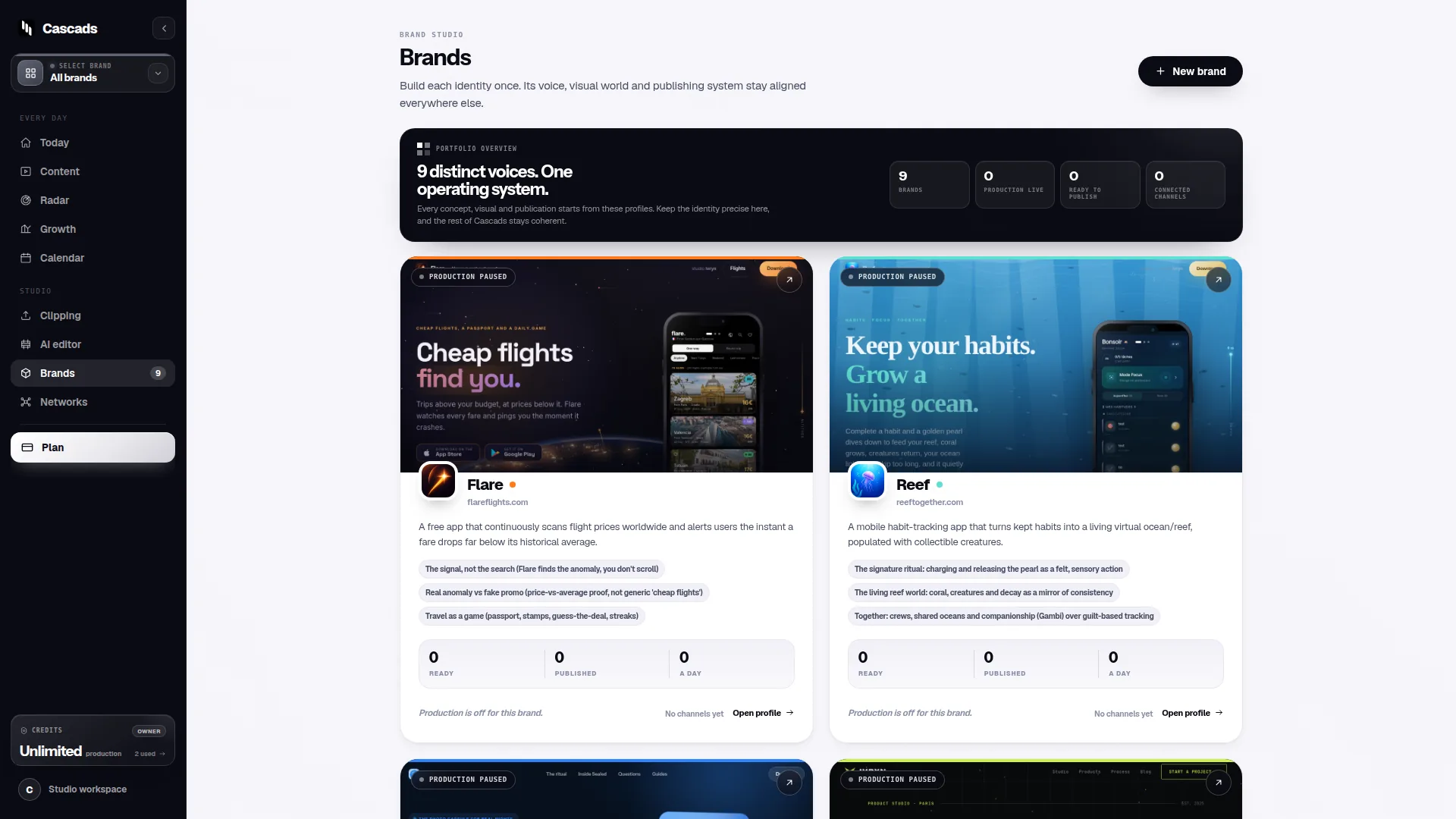
For small teams and agencies running content across several brands, the recurring pain point is not writing one post but reproducing consistent output at volume without starting from a blank page every time. This is the specific gap that a product like Cascads, from IVRYN, is built around: it generates text posts, vertical videos and carousels from a reusable profile defined for each brand, so tone, format preferences and brand context do not need to be reconstructed manually for every piece of content.
That kind of brand-context reuse matters more as the number of brands or clients grows. A single freelancer managing one account can often work directly in a network's native scheduler. An agency managing a dozen brands across multiple networks benefits from a system that keeps each brand's voice and format defaults separate but reusable, rather than relying on a shared template that drifts toward generic output over time.
It is worth being clear about what automation in this context does and does not mean. It does not mean content appears and publishes itself without oversight. It means the repetitive parts of production, drafting variations, adapting a single idea into a post, a video and a carousel, are handled by the system, while a person still decides what goes live.
The limits that free options do not remove
No automation tool, free or paid, removes the structural constraints of the platforms themselves. Direct publishing depends on the network in question, the media format being posted, the permissions granted to the connected account, and approval from the external platform. These constraints exist independently of price. A free tool and a paid one are both subject to the same platform-side restrictions on what can be published directly versus what requires manual posting.
This is a common source of disappointment with free social media automation: teams expect a tool to guarantee direct publishing everywhere, and instead find that some networks or formats require manual steps regardless of the software used. Checking a tool's publishing integration coverage against your specific mix of networks and formats before committing is more useful than assuming automation implies universal direct publishing.
A second limit that applies regardless of budget is human review. Generated marketing output, whatever the source, should go through a review step before publication. This is not a workaround for weak automation; it is a baseline practice for brand and compliance reasons. Any workflow, free or paid, that treats generation as a replacement for review is taking on avoidable risk.
A worked example: evaluating a free option for a five-brand agency
Consider a hypothetical small agency managing five client brands across three networks, with a mix of image posts, short vertical video and occasional carousels. This is an illustrative scenario, not a case study or reported outcome, but it is useful for walking through what to actually check.
First, count connected accounts and brands against the free tier's cap; five brands across three networks often exceeds what a free plan allows, forcing either multiple free accounts (usually against terms of service) or an early upgrade. Second, check format support: if the free tool only handles static images, the video and carousel formats will need a separate process, undermining the efficiency gain automation was meant to provide. Third, check whether each brand can maintain a distinct voice and profile, or whether the tool assumes one generic account.
In this scenario, a team might reasonably conclude that a free tier works for a pilot with one or two brands, but that evaluating a paid or brand-profile-based approach becomes necessary once the brand count and format variety increase. The decision point is not about the word 'free' itself, but about whether the tool's structure, account limits, format coverage, and brand separation, matches the actual production load.
- Count brands and connected accounts against the plan's cap, not just the price
- Confirm which post formats (text, vertical video, carousel) are actually supported, not just scheduled
- Check whether each brand can keep a separate reusable profile or voice
- Verify direct publishing coverage per network and format before assuming it works everywhere
- Confirm a human review step is built into the workflow, regardless of plan tier
A short checklist before choosing a free option
Before adopting any tool under the social media automation free umbrella, it helps to separate cost questions from capability questions. Cost tells you what you can afford today; capability tells you whether the tool will still fit your workflow in three or six months as brand count or format needs grow.
The following checklist is a practical starting point rather than an exhaustive audit. It is meant to be applied against whatever specific tool or tier you are considering, using that tool's own current documentation for exact limits and supported networks, since these details change over time and are not fixed facts to memorize.
- Is this a free tier, a time-limited trial, or a permanently free tool, and does that match your planning horizon?
- What is the account, brand or post-volume cap, and how does that compare to your current and near-future needs?
- Which post formats are supported for generation and which for direct publishing, and are those the same list?
- Does the tool support per-brand profiles, or would you need a workaround for multiple brands?
- Is there a clear point in the workflow where a human reviews content before it goes live?
Where Cascads fits, and where it does not decide for you
Cascads is built for the specific case of producing social content, text posts, vertical video and carousels, at volume across several brands, using a reusable profile per brand rather than reconstructing brand context each time. That is the product's scope, and it is a useful frame for anyone comparing it against free or lower-cost alternatives: the value is concentrated in multi-brand, multi-format production, not in being the cheapest possible way to schedule a single account.
Cascads does not remove the platform-level constraints described earlier. Direct publishing still depends on the network, the format, account permissions and external platform approval, and generated output still goes through human review before publication, the same way it would with any other tool. Anyone choosing between free options and a product like Cascads should weigh these constraints against their own brand count, format needs and review process, rather than expecting any tool, free or paid, to remove them entirely.
Frequently asked questions
Is social media automation ever fully free with no limits?
Generally no. Free options are typically a limited tier of a paid product, a time-limited trial, or a genuinely free tool with a narrower feature set, such as fewer connected accounts, brands, or supported formats. It helps to identify which of these you are looking at before comparing options, since each has different long-term tradeoffs.
Does automation guarantee my posts publish directly to every platform?
No. Direct publishing depends on the specific network, the media format being posted, the permissions granted to the connected account, and approval from the external platform itself. This applies regardless of whether the automation tool is free or paid, so it is worth checking a tool's publishing coverage for your specific networks and formats before relying on it.
Can I skip human review if the content is generated automatically?
No. Generated marketing content, whether produced by a free tool or a paid platform, should still go through human review before publication. This is a baseline practice for brand accuracy and compliance, not a limitation specific to any particular tool or price point.
Sources and further reading
These resources provide the wider reference frame. Product statements on this page are limited to the public information provided by Cascads.