Why scheduling breaks down for multi-brand teams
Most teams learn how to schedule posts one network at a time: pick a tool, connect an account, queue content. That approach works until a second brand, a second network, or a second approver enters the picture. At that point the real question isn't which button schedules a post - it's how the team keeps brand context, format requirements and sign-off intact as volume grows.
The friction usually shows up in three places: content built for one format gets forced into another, a post goes out before the right person has seen it, and a queue that looked full on Monday is empty by Thursday because nobody tracked what was actually approved versus drafted. None of these are scheduling failures in the narrow sense - the post-at-time-X mechanism works fine. They're workflow failures that scheduling alone doesn't fix.
A useful frame is to separate three layers: production (who makes what, for which brand and network), review (who approves it and when), and publishing (what actually reaches the platform, and under what constraints). Scheduling tools tend to be strong on the third layer and weak on the first two, which is where multi-brand teams lose time.
Start from brand context, not from the calendar
A calendar-first approach to scheduling assumes the content is already correct and just needs a time slot. For teams running several brands, that assumption rarely holds - tone, visual identity and even permitted formats can differ brand to brand. Starting from a reusable brand profile, rather than a blank draft, reduces the chance that a post is scheduled and later pulled for tone or format mismatch.
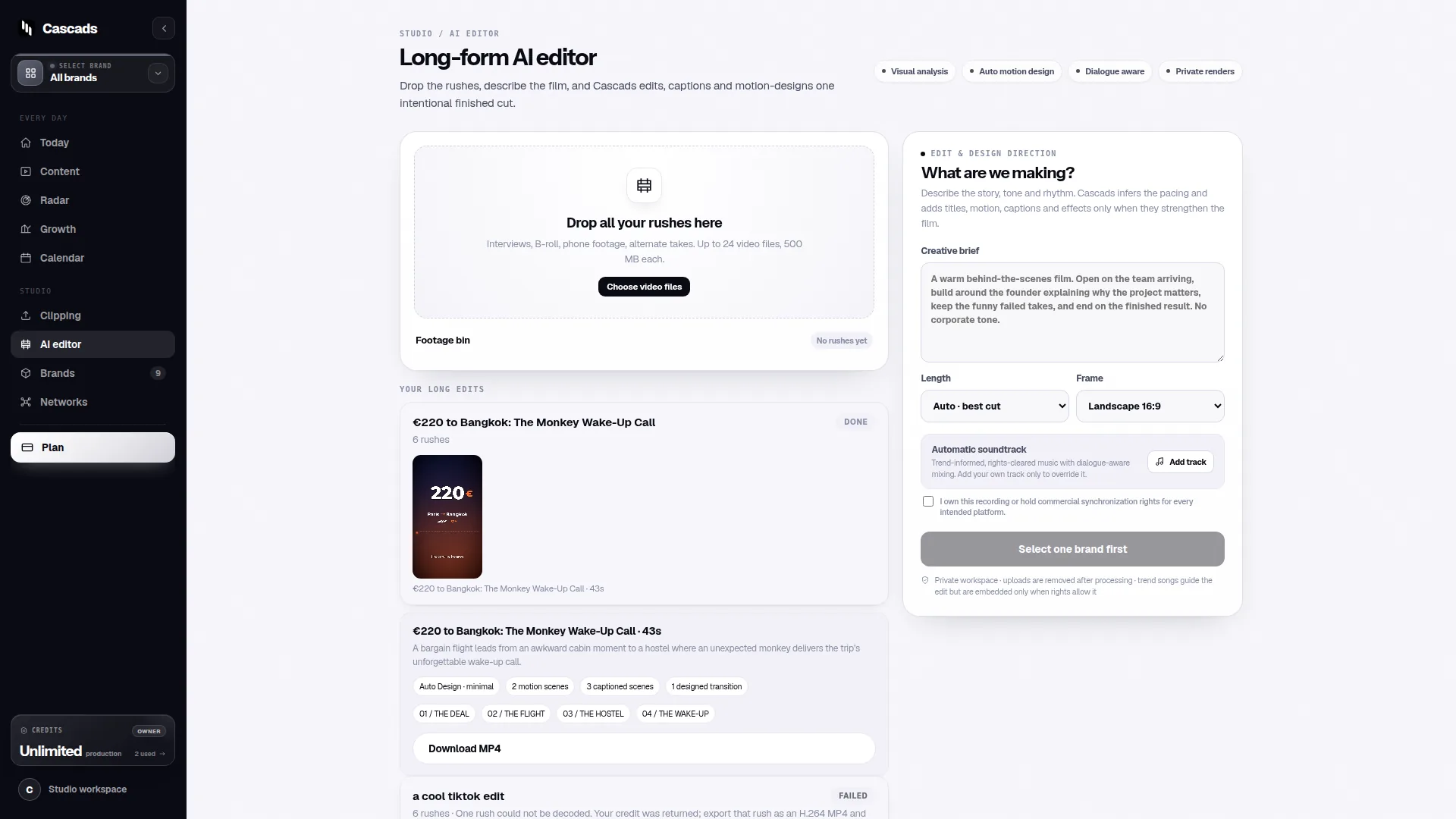
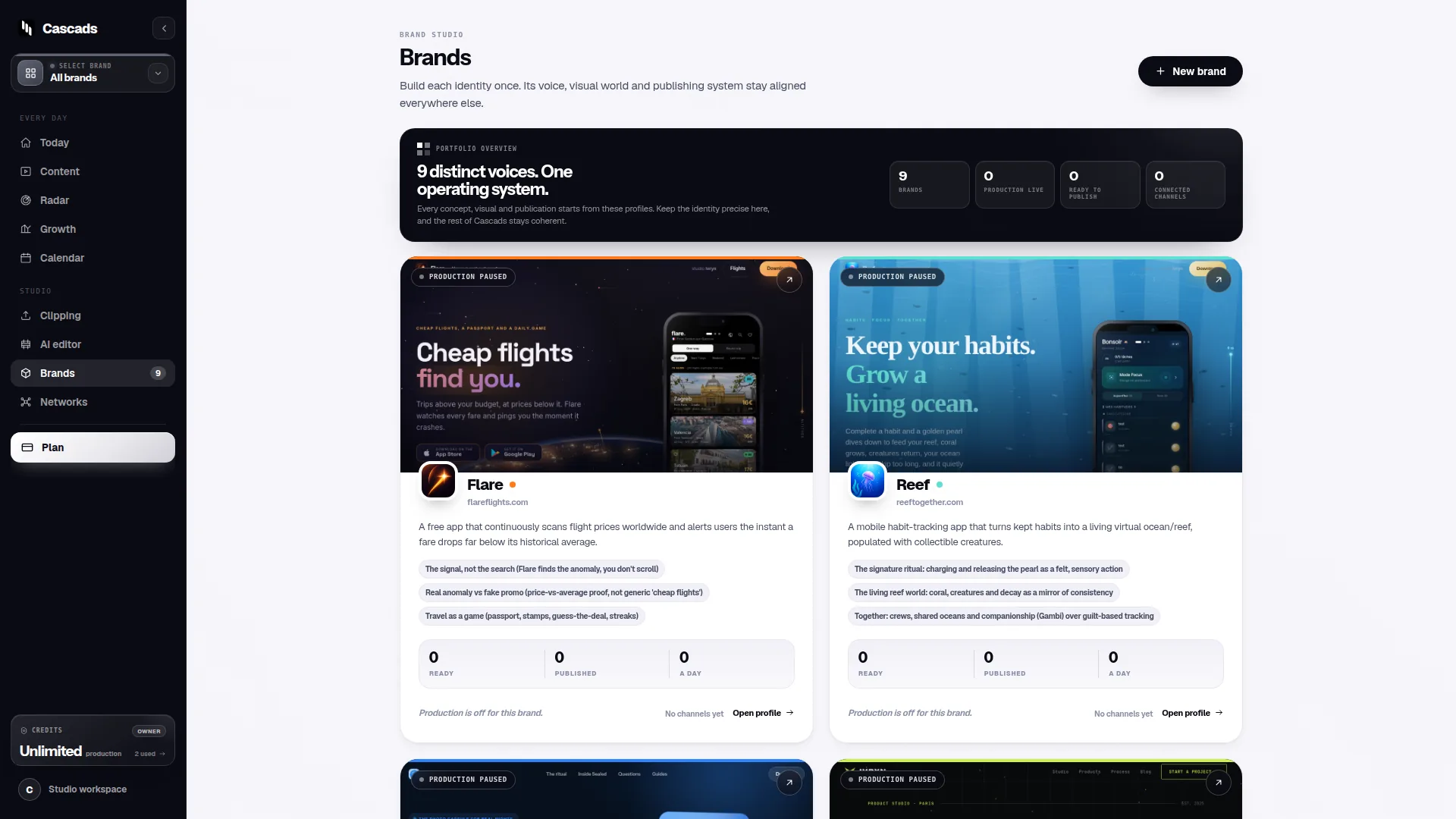
This is part of how Cascads approaches the problem: it generates text posts, vertical videos and carousels from a reusable profile built for each brand, so production for a new brand doesn't start from zero and doesn't rely on someone remembering unwritten style rules. That doesn't remove the need for a human to check the output, but it does mean the starting point is already aligned with the brand rather than generic.
Practically, a brand profile should capture enough to guide format and tone decisions - audience, voice, visual constraints, and which networks the brand is actually active on. Teams that skip this step tend to compensate with more review cycles later, which slows the queue down rather than speeding it up.
Build for the format before you build for the calendar
Scheduling across networks fails quietly when the same asset is stretched across formats it wasn't designed for - a square image cropped into a vertical video slot, or long-form text trimmed to fit a caption limit at the last minute. This is a production problem, not a publishing problem, and it needs to be solved before anything reaches a queue.
Multi-format production means treating text posts, vertical video and carousels as distinct outputs from the start, each shaped for how a given network actually displays it, rather than one asset reformatted under time pressure. Producing for the intended format up front reduces the number of last-minute edits that stall a queue.
It also matters for what happens after scheduling. Direct publishing depends on the network, the media format, the account's permissions, and external platform approval - a constraint that applies regardless of which tool is used. A well-formatted post scheduled well in advance can still be delayed by a platform-side review or a permissions gap on the connected account, which is why format-readiness and publishing-readiness need to be checked separately, not assumed to be the same thing.
Design the approval step so it doesn't stall the queue
Human review is a required checkpoint, not an optional one - generated marketing output should be reviewed by a person before it publishes, and that's true whether the content was written by a single marketer or produced across five brands at once. The risk for multi-brand teams isn't skipping review; it's approval becoming a bottleneck that nobody can see into.
A social media approval workflow works best when it's visible: who needs to sign off, in what order, and what happens if a post sits unapproved past its intended slot. Without that visibility, teams either publish late or, worse, someone bypasses review to hit a deadline. Building the approval step into the same view as the content calendar - rather than as a separate email thread or chat message - keeps the two in sync.
For agencies managing client brands specifically, it also helps to decide in advance who owns final sign-off per brand. A shared workflow without a clear approver just moves the bottleneck from 'who reviews this' to 'who's actually allowed to approve this,' which is a harder problem to untangle mid-queue.
- Define one named approver per brand, not a rotating group
- Set a cutoff time before the scheduled slot for review to be complete
- Log what was approved, not just what was drafted
Worked example: scheduling three brands across two networks
This example is illustrative, not a case study or reported result - it's meant to show how the pieces fit together, not to claim an outcome. Imagine a small agency running three client brands, each posting to a vertical-video network and a text-and-image network, with one shared reviewer covering all three accounts.
The team would first set up a brand profile for each client, capturing tone and visual constraints separately so content generated for Brand A doesn't drift into Brand B's voice. Content is then produced in the format each network actually needs - vertical video drafts and carousel drafts kept distinct rather than one asset repurposed for both - so nothing needs re-editing right before a scheduled slot.
Approval is scheduled with a buffer: content for Monday's slots is due for review by Friday, giving the shared reviewer time across all three brands instead of a same-day scramble. Only after approval does a post move into the schedule, and even then, the team checks account permissions and platform-approval status for that network, since a permissions gap or a platform-side review can delay publishing even after the content itself is approved.
The result, in this hypothetical, isn't a guarantee that every post goes out exactly on time - external platform approval and account permissions remain outside the team's control - but the queue stays predictable because brand context, format and approval status are tracked as separate, visible steps rather than assumed.
A short checklist before you schedule
Before adding a post to a schedule, it helps to run through a small set of checks rather than trusting that a full-looking calendar means a ready one. This is especially true for teams juggling several brands, where a single missed check can affect a client relationship as well as a publishing slot.
The checklist below is deliberately short. It's meant to catch the failure modes described above - mismatched brand voice, wrong format, missing approval, and unverified permissions - before they show up as a delayed or pulled post.
- Does this post match the brand profile it was generated from?
- Was it produced in the native format for this network, not adapted from another?
- Has a named person actually approved it, not just seen a draft?
- Are the connected account's permissions current for this network?
- Is there a fallback plan if platform approval delays publishing?
Frequently asked questions
What's the difference between scheduling a post and it actually publishing on time?
Scheduling sets an intended time for a post to go out, but the post reaching the platform depends on additional factors such as the network's rules, the media format, the connected account's permissions, and platform-side approval. A post can be fully scheduled and still be delayed by any of these, so teams should treat scheduling and successful publishing as related but separate steps.
Should every scheduled post go through human review, even for small updates?
Yes - generated marketing content should be reviewed by a person before publication regardless of how minor the update seems, since even small changes can affect brand tone or compliance. Building a lightweight, visible approval step into the scheduling process is more sustainable than relying on ad hoc checks.
How should a team handle scheduling when it manages multiple brands with different formats?
Start from a distinct brand profile for each brand so tone and visual constraints stay separate, then produce content natively for each required format - such as text posts, vertical video, or carousels - rather than adapting one asset across formats. Keeping brand context and format production separate reduces the rework that typically causes scheduling delays.
Sources and further reading
These resources provide the wider reference frame. Product statements on this page are limited to the public information provided by Cascads.